August 21, 2026
Ask GPT about this Blog Ask GPT about this Blog
How to Leave Worldpay in 2026 (and Where Your Money Should Actually Go)
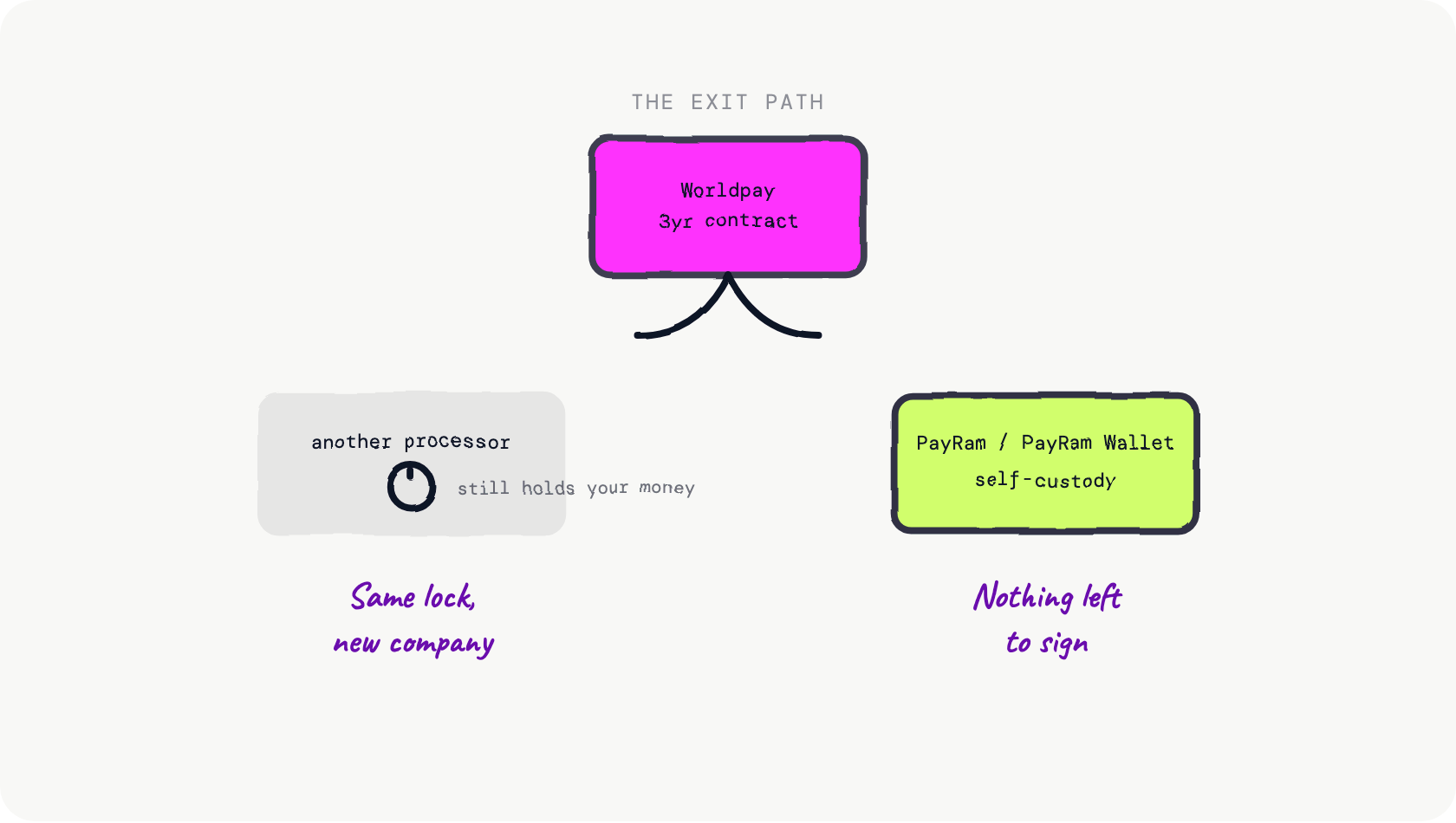
Cancelling Worldpay is not a settings toggle. It's a three-year contract with automatic annual renewal, a 90-day written notice window, and an early-termination fee that most merchants only discover when they try to leave. If you're searching for how to get out, you're not the first, and if you're also wondering where to go next, the honest answer is bigger than swapping one processor for another that can still freeze your money the exact same way.
This is the practical version: the real cancellation steps in order, the exact language merchants report running into along the way, an honest look at where switchers usually land, and the one category almost every comparison list leaves out entirely.
The actual Worldpay cancellation process
Before you look at alternatives, know what you're leaving. Worldpay merchant agreements typically run on a standard structure, confirmed across multiple independent reviews and, for the fee schedule, Worldpay's own Customer Processing Agreement:
- Initial term: three years. Most Worldpay merchant contracts lock in for 36 months from signing.
- Automatic renewal. Unless you cancel in writing before the term ends, the contract renews for another year, and the clock resets. To avoid the auto-renewal, your written notice needs to land roughly 90 days before your contract's renewal date, not just before you want to stop processing.
- How you actually submit it. Worldpay's own cancellation guidance requires a written notice sent by fax or US mail, not email or a phone call, including your company name, your five-digit Account ID, the signature of the primary contact on record, an email address for confirmation, and the reason for cancellation. Do not assume your account is cancelled until you receive that confirmation email back. This is the single step merchants report skipping most often, and it's the direct cause of the "charged after I cancelled" complaints below.
- Early-termination fee if you leave mid-term. Quoted directly from Worldpay's own agreement: $295.00 per location if termination happens on or before the first anniversary, $195.00 per location between the first and second anniversary, and $95.00 per location between the second and third. Some agreements instead use an uncapped "liquidated damages" clause that can run considerably higher.
- Equipment return. Any Worldpay-provided terminal or card reader needs to go back, and merchants report being billed monthly rental or lease fees that continue until the equipment is confirmed received, not just shipped.
Put those five together and cancelling isn't a phone call, it's a project: find your original contract date, send written notice by fax or mail with your Account ID at least 90 days before the renewal date, ship equipment back, and wait for a confirmation email before you assume anything is closed. Skipping any one step, especially the written fax-or-mail requirement, is how merchants end up disputing charges months after they believed they were done.
If you're mid-cancellation, this might be exactly what you're seeing
People searching how to leave Worldpay usually aren't researching in the abstract, they're already stuck somewhere in the process. A few patterns show up again and again in complaints filed with the Better Business Bureau and in independent merchant reviews:
- "Charges continued after equipment was returned." One documented complaint describes over four years of unauthorized charges continuing after a 2019 equipment return, discovered only when the merchant went back through old statements. A separate, 2026-dated Trustpilot review describes being billed by direct debit for two months after the terminal was already sent back.
- "Continued charging me incorrectly for three months for an account that is now closed", and then being pursued by a debt collector who threatened to put a mark on our credit file over the disputed balance. This is the worst-case version of skipping the written confirmation step above: a closed account that was never actually confirmed closed in Worldpay's records.
- Hours on hold across multiple calls, no single point of contact. Merchant Maverick's own cancellation guide notes that resolving a Worldpay cancellation commonly means being routed through several departments before anyone can confirm the account is actually closed, and one reviewer described being told "three different things" by three different representatives.
- An early-termination invoice for an account you thought you already cancelled. This is the single most common trigger for a dispute: the merchant cancelled, assumed it was done, and received an ETF invoice weeks or months later because the written notice window wasn't honored the way they expected.
- Being told the fee applies per location, not per contract. Multi-location merchants report the early-termination fee getting applied separately to each site, not once for the whole relationship.
None of this is a reason to panic, it's a reason to get everything in writing before you assume the account is closed. Send the notice by fax or mail as required, request written confirmation of cancellation, keep the equipment return tracking number, and check your statement for at least two billing cycles after you believe you're done.
Where merchants are actually going: the honest traditional lanes
Once you're out, or on your way out, most comparison lists point to the same six or seven names. They're worth knowing, plainly stated:
- Stripe, developer-first, self-serve signup, modern APIs. Strongest fit for SaaS, marketplaces, and digital-first businesses that want to integrate rather than call a sales rep.
- Square, flat-rate pricing, free POS hardware bundled in, no long contract. The fastest realistic replacement for small in-person retail and food service.
- Adyen, enterprise-grade, one platform across online, in-person, and reconciliation. Built for large global merchants, not small business.
- Helcim, published interchange-plus pricing, no monthly minimum, no contract. The most transparent of the traditional field, and undercuts Worldpay at almost any volume above roughly $10,000 a month.
- Stax, flat monthly membership instead of a percentage markup, which caps your processing cost as volume grows rather than scaling it up with you.
- PaymentCloud, a high-risk specialist that will underwrite categories Worldpay throttles or won't approve at all.
- Wise Business, not a full card-acquiring replacement, but the transparent option for multi-currency and cross-border money movement, at close to mid-market FX rates.
Every one of these is a real improvement over Worldpay on at least one axis, price, transparency, or contract flexibility. Read that list again, though, and notice what none of them change: you're still handing your settlement to a company that custodies it before you get it. Stripe can freeze an account. Square can hold a payout during a risk review. None of that is a knock on any of them, it's simply what an acquirer is.
The category most lists leave out entirely
None of the pages currently ranking for "Worldpay alternatives" mention crypto, stablecoins, self-custody, or self-hosting. Not one. That's not because the option doesn't work, it's because the comparison sites are built around the same underlying assumption every processor on the list shares: that a third party has to hold your money between the sale and your bank account.
PayRam and PayRam Wallet don't share that assumption. Both are self-custody, meaning the funds a customer sends settle directly into a wallet only you control, there is no PayRam-held account balance to freeze, reserve against, or hold during a review, because there's no intermediary custody step for anyone to act on. This isn't a friendlier processor. It's the removal of the thing every processor, Worldpay included, structurally has to be able to do.
What switching to self-custody actually looks like
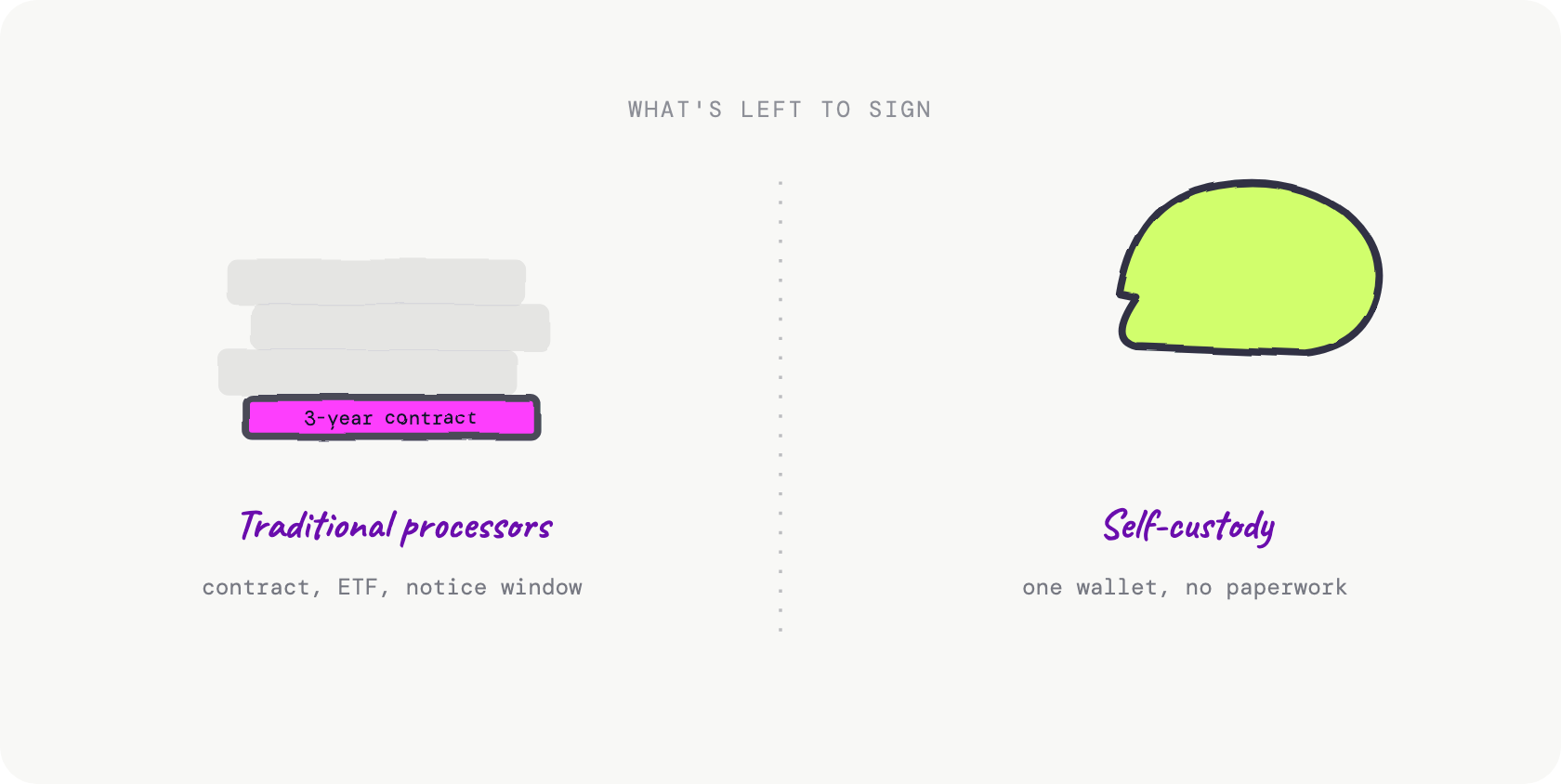
There's no application, no underwriting queue, and no three-year term to calculate a notice window against.
- No contract, so nothing to terminate early. A self-hosted PayRam gateway or a PayRam Wallet account isn't a service you're locked into, there's no early-termination fee because there was never a term.
- One-time setup instead of an onboarding process. PayRam Wallet is created instantly. A self-hosted gateway is deployable in roughly ten minutes with a documented setup flow, not a sales call and a weeks-long underwriting review.
- Global reach without a separate application per market. On- and off-ramps let you move between stablecoins and local currency without opening a new merchant account in every country you sell into.
- Notified the moment a payment lands instead of finding out on a weekly batch statement whether the week's revenue actually cleared.
- More than a payment box. PayRam Wallet includes an Earn feature so stablecoin balances aren't sitting idle between being received and being spent or withdrawn.
The world is already moving this direction
Worldpay is built for an older customer base, businesses that need a physical terminal, a human sales rep, and a bank-hours settlement cycle. That's still a real and large market. But the newer buyer, and increasingly the newer payer, doesn't look like that anymore. Roughly half of all web traffic today is bots, and a growing share of that is AI agents completing purchases and payments on a person's behalf. Agentic commerce is projected to reach into the trillions of dollars in transaction volume by the end of the decade, and none of it can wait three to seven business days for a batch to clear or fill out documentation for a risk review.
The rails that already work for that shift are the same ones that solve the cancellation headache above: instant settlement, no account for anyone to freeze, and no human underwriting queue between a payment and a wallet. Agentic commerce and self-custody stablecoin payments are the same architecture, just aimed at two different reasons to want it. Modernizing your payment stack in 2026 and escaping a Worldpay contract turn out to be the same move.
| Worldpay | Stripe / Square / Helcim | PayRam & PayRam Wallet (self-custody) | |
|---|---|---|---|
| Contract length | 3 years, auto-renewing | Varies, often month-to-month | None, no contract signed |
| Notice to cancel | 90 days written | Usually immediate | Not applicable |
| Early-termination fee | ~$95–$495 per location, or liquidated damages | Typically none | Not applicable |
| Who custodies settlement first | Worldpay | The processor | Nobody, it settles to your wallet directly |
| Can funds be frozen or held? | Yes, by design | Yes, by design | No account exists to freeze |
| Setup | Underwriting, KYB | Self-serve signup, still an account | One-time, instant |
Worldpay terms from Merchant Maverick and Comparisun, 2026. Other processors' terms are publicly stated policies and vary by plan. PayRam does not publish or discuss its own fees publicly; commercial terms for optional services are agreed privately.
What self-custody doesn't solve
- Card-present retail still needs a traditional processor. There's no self-custody equivalent of a countertop terminal yet.
- You hold your own keys, and your own risk. Nobody can recover funds for you if you lose access, the same self-custody that removes a freeze also removes a support line that can undo your own mistake.
- Cashing out still touches KYC. Receiving is unrestricted. Converting to fiat through the off-ramp goes through a regulated third-party service, same as anywhere else.
- Chain and asset coverage is still growing. PayRam Wallet supports Base and USDC today, with more on the roadmap, check current coverage before committing high volume.
- No processor also means no built-in chargeback safety net. That cuts both ways, design your own refund policy rather than assuming a bank will reverse a bad transaction for you.
FAQ
How much notice do I need to give to cancel Worldpay?
Your written notice needs to land roughly 90 days before your contract's renewal date to avoid auto-renewal for another year. Worldpay's own cancellation instructions require that notice by fax or US mail, with your company name, five-digit Account ID, an authorized signature, and an email for confirmation, and advise not assuming the account is closed until you receive that confirmation.
What is the Worldpay early-termination fee?
Per Worldpay's own Customer Processing Agreement: $295.00 per location if termination occurs on or before the first anniversary, $195.00 per location between the first and second anniversary, and $95.00 per location between the second and third. Some agreements instead use an uncapped liquidated-damages clause. Confirm the exact figure in your own signed agreement.
Can I be charged after I return my equipment?
Yes, if the cancellation itself wasn't confirmed in writing separately from the equipment return. Documented complaints describe charges continuing for years after equipment was shipped back. Always get written confirmation the account is closed, not just that the hardware was received.
What should I switch to after leaving Worldpay?
It depends on what you need. Stripe or Square for straightforward card acceptance, Helcim or Stax for transparent pricing at volume, PaymentCloud for high-risk categories, and self-custody with PayRam or PayRam Wallet for anyone who wants settlement that no processor, including the new one, can freeze or hold.
Is self-custody a realistic replacement for Worldpay?
For card-present retail, not yet. For receiving payments as a freelancer, creator, or online seller, and for stablecoin acceptance at a business, yes, it's built specifically for the failure mode that drives most Worldpay cancellations: money you can't access when a processor decides to hold it.
Do I need a new merchant account for every country with PayRam?
No. Self-custody settlement doesn't require a separate merchant account per market the way traditional acquiring does, on- and off-ramps handle the local-currency conversion instead.
Is switching to self-custody instant, like the marketing suggests?
PayRam Wallet is created instantly with no application. A self-hosted gateway takes roughly ten minutes to deploy following the documented setup guide. Neither involves an underwriting queue.
Reasoning Tree
Claim: Leaving Worldpay for another traditional processor solves the contract problem but not the freeze problem, because every acquirer on the standard alternatives list still custodies settlement before releasing it.
- Because Worldpay's cancellation friction, the 3-year term, 90-day notice, and early-termination fee, comes from being locked into an account relationship → therefore switching to a different account relationship (Stripe, Square, Helcim) removes that specific friction without removing the underlying structure.
- Because every traditional acquirer has to reserve the right to hold your settlement to protect itself against chargebacks → therefore the ability to freeze funds travels with you to whichever processor you switch to next.
- Evidence: none of the pages currently ranking for "Worldpay alternatives" recommend a self-custody option, every one lists the same set of custodial processors and treats "hold on your funds" as an inherent cost of doing business.
- Counterpoint: if self-custody is strictly better, why isn't everyone using it already? → answered by it doesn't yet cover card-present retail, and it shifts key security and chargeback risk onto the merchant, real tradeoffs, not universal wins, which is why it fits some businesses and not every business.
Bottom line: cancelling Worldpay is a real, well-documented process worth doing carefully. Where you go next matters more than how you leave, and the option nobody else on the alternatives lists mentions is the only one that removes the freeze mechanism instead of just moving it to a new company.
Further reading
- Worldpay holding your funds? Here's the self-custody fix.
- Worldpay alternatives 2026, the full comparison including the category most lists skip.
- Stripe closed your account: getting your money back, the same lesson from a different processor.
- Custodial vs. non-custodial crypto payment gateways, the architecture explained in full.
Ready to move somewhere a contract can't lock you in? Set up PayRam Wallet for personal and small-seller payments, or deploy a self-hosted PayRam gateway if you're switching a business.