August 20, 2026
Ask GPT about this Blog Ask GPT about this Blog
Worldpay Holding Your Funds? With Self-Custody, There's Nothing to Freeze
When Worldpay holds your funds, it is not a glitch, it is the design. Your money sits in an account Worldpay controls, and a risk review, a chargeback spike, or a single large transaction is enough to freeze it for weeks with no fixed deadline to get it back. The fix people keep reaching for is a better processor. The fix that actually works is removing the account: with a self-custody wallet, your funds never sit anywhere Worldpay, or anyone else, can put a hold on them.
This is the merchant version of a story that repeats on the Better Business Bureau's Worldpay page every month: a clean chargeback history, a normal sales week, and then a hold notice with no clear end date. Below is what's actually happening when that hold lands, the exact language merchants report searching for when it does, and the architectural difference between a processor that can freeze your money and a wallet that was never able to in the first place.
What "Worldpay is holding my funds" actually means
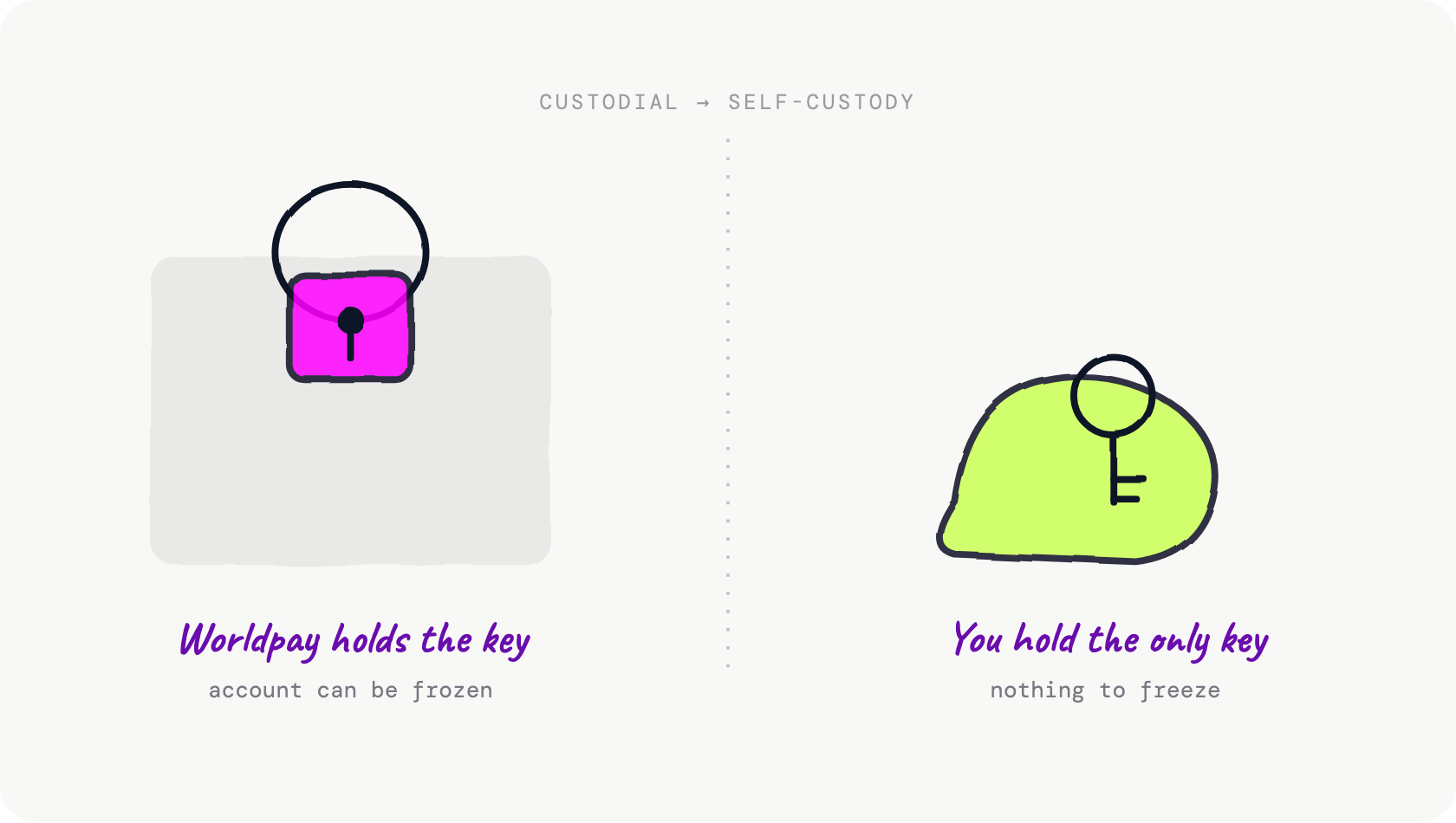
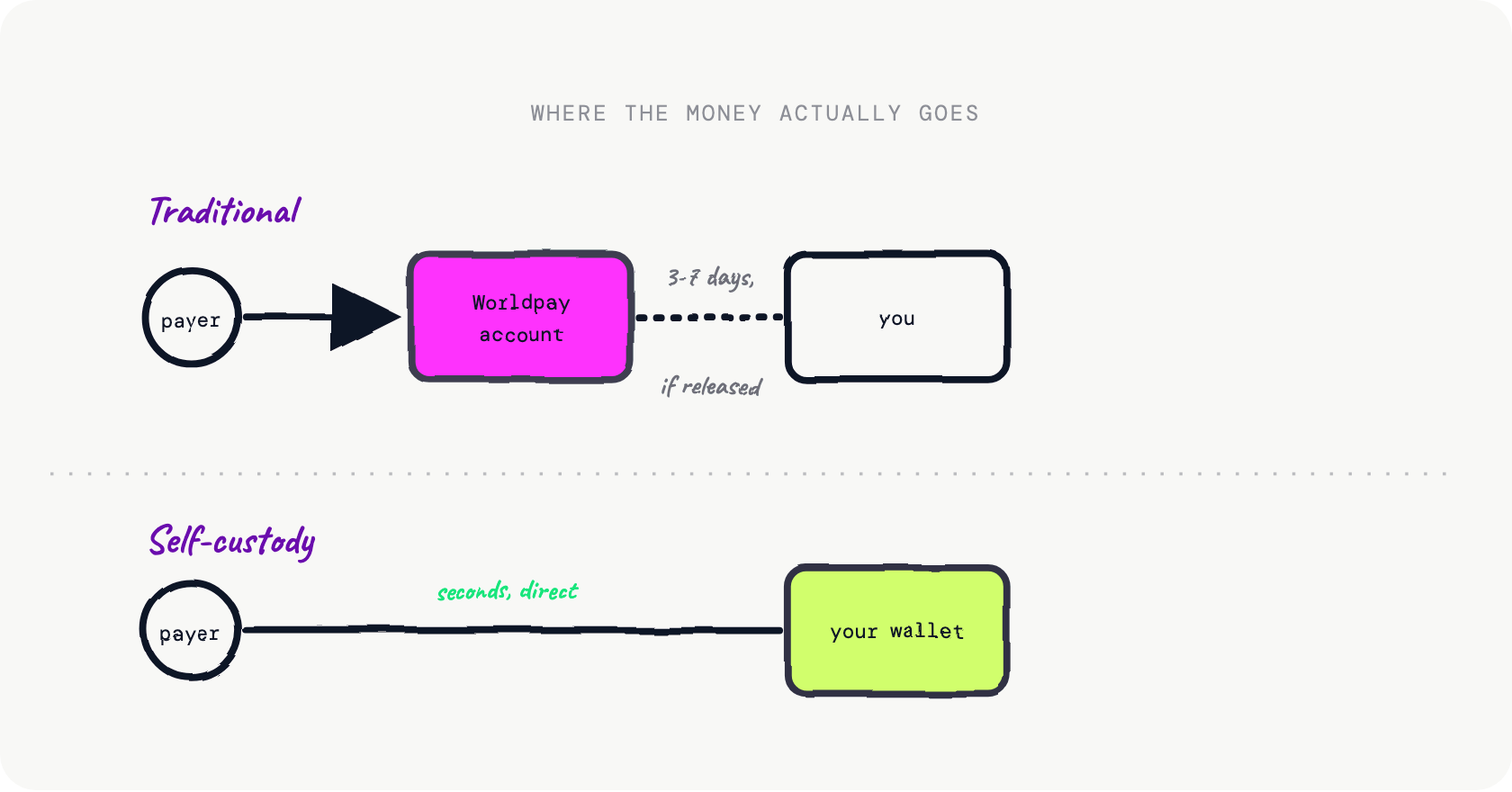
Worldpay is a merchant acquirer. When a customer pays, the money does not land in your bank account directly, it lands in an account Worldpay controls on your behalf, and Worldpay releases it to you on its own schedule, typically in batches over three to seven business days. A "hold" is Worldpay choosing not to release a batch, usually triggered by an automated risk flag: a transaction above your normal average, a spike in refund requests, a new SKU, a chargeback, or nothing you can point to at all.
Merchant complaints filed with the Better Business Bureau describe the pattern consistently: a business processes normally for months, a review is triggered, and funds are held with no fixed release date while the merchant is asked to submit documentation and wait. One merchant reported two charges flagged as fraudulent and, as a result, over $100,000 of business funds held for roughly a month. Others describe being unable to make payroll or pay suppliers while the review runs its course, sometimes with no advance notice that a hold was coming at all.
If you've searched this, you're not alone
A specific kind of search brings people to pages like this one: not "Worldpay alternatives" in the abstract, but the literal words on the screen or in the email in front of them. If any of the following sounds familiar, word for word, you're dealing with exactly the mechanism described above, not a mistake specific to your account. These are direct quotes from filed, dated complaints, not paraphrases.
- "During their risk review, they put our funds on HOLD." One merchant's exact description of discovering the hold, from a March 2024 BBB complaint, after only noticing because of a routine status email. Another merchant in the same thread reported Worldpay was "holding over $85k" of their money with no release date given.
- "Without acceptable arrangements or resolution of the issue, service to your merchant processing account may be terminated." Reported verbatim from a Worldpay warning notice in a March 2024 complaint. If you've received language like this, it means the review has escalated past a routine hold, respond to whatever documentation request came with it as completely and quickly as you can.
- "They flagged 2 charges as fraudulent... and now are sitting on over 100k of our business funds." A single miscategorized charge limit triggered a month-long hold on the entire account, not just the flagged transactions, per an October 2023 complaint.
- "They already terminated my account and stole my money." From a Trustpilot review dated August 2026, titled "If I could give 0 stars I would." However strong the language, it reflects a real, recent, and common outcome: termination and fund retention happening together, with no advance resolution path offered.
- Unexplained rate or fee changes on a statement you didn't authorize. One BBB complaint reports being charged an extra $8,113 since November 2020 from undisclosed fee increases; another alleges roughly $15,120 in overcharges. A separate, unrelated reviewer put it more plainly: "they had no problem charging fees on those very same closed accounts."
- A cancellation fee invoice, or a debit, arriving after you already returned the equipment. A 2026 Trustpilot review describes being billed by direct debit for two months after sending back the terminal, and being threatened with a mark on a credit file by a collections agency over a disputed three-year-old balance on an account the merchant believed was closed.
None of this means Worldpay singled you out. It means the review triggered on your account this time. The same trigger logic sits underneath every acquirer that custodies your money before it becomes yours, Worldpay is simply the one with the largest, longest complaint trail because it is one of the largest acquirers in the world.
Why it keeps happening: rolling reserves and undisclosed terms
Beyond one-off holds, higher-risk or higher-volume merchants can be placed on a rolling reserve, a standing percentage of every batch withheld for a fixed window (commonly 90 to 180 days) as a buffer against future chargebacks. Worldpay does not publish its reserve schedule or its risk-review thresholds anywhere a merchant can read them in advance. Reviewers who cover the space are blunt about it: get the rate, the reserve, and the exit terms in writing before you sign, because none of it is public.
That opacity is not an accident of a badly maintained help page. It's structural. A processor that custodies your settlement has to reserve the right to hold it, because the processor, not you, is the one exposed if a chargeback wave hits after the money has already gone out. The processor is protecting itself. The terms it uses to do that are the terms you're reading in a hold notice.
Worldpay's own published complaints policy states it aims to "investigate and fully resolve complaints within 15 business days," with cases running "up to 45 days depending on the issue and complexity," and an acknowledgment of receipt promised within five business days. That is Worldpay's own stated ceiling, not a merchant's estimate. If a hold on your account has already run past that window without resolution, you're not being impatient, you're past the timeline Worldpay itself publishes.
The fix isn't a better processor, it's no processor to freeze you
Every acquirer, Worldpay included, has to build in the ability to hold your money, because every acquirer custodies it first. Switching from Worldpay to another traditional processor moves you to a different company with the same structural power. It doesn't remove the power.
PayRam and PayRam Wallet are both self-custody, end to end. A payment made to a self-hosted PayRam gateway settles directly to a wallet only the merchant controls, PayRam's servers never hold the private key and never touch the funds in transit. A payment received in PayRam Wallet lands directly in a wallet only you control, the same architecture, built for individuals instead of a business. In both cases there is no account balance sitting anywhere for a risk team to review, flag, or hold, because there is no intermediary custody step in the first place. Nothing to freeze is not a policy PayRam offers. It's a description of where the money physically is.
What self-custody looks like in practice with PayRam Wallet
PayRam Wallet is a self-custodial stablecoin wallet built around one rule: your keys, your crypto, and PayRam has no access to your funds at any point. In practice that means:
- One-time setup, not an application. The wallet is created instantly, there is no underwriting queue, no risk-review form, and no waiting period before you can receive your first payment.
- Nothing to freeze because there's nothing to hold. Funds you receive settle directly to your own wallet. There is no PayRam-held balance sitting between "customer paid" and "you have it."
- Ramps in and out, without becoming custodial in the middle. Add funds and withdraw straight to a bank account when you want to cash out, PayRam Wallet is the receive-and-hold layer, the ramp is the on- and off-ramp, and your balance in between is yours alone.
- Notified the moment money lands. Because settlement is instant and on-chain, you get a payment notification when funds arrive, rather than waiting on a batch cycle to find out whether this week's revenue actually cleared.
- More than a payment box. Beyond send and receive, the wallet includes an Earn feature so idle stablecoin balances aren't sitting doing nothing between the moment you're paid and the moment you spend or withdraw.
- Private, not a marketing claim. PayRam Wallet does not share your data with third parties. Be precise about what "private" means here: opening the wallet itself takes no KYC, but if you use the built-in fiat off-ramp to move money to a bank account, that ramp is a regulated, KYC-checked third-party service, the same as any fiat off-ramp anywhere. Self-custody and privacy describe how your funds are held and who sees your wallet activity, not a claim that every step in a stablecoin-to-bank-account journey is anonymous.
This is also why a no-keys-on-server architecture is the real answer to "what happens if my processor decides to hold my money," on the business side as much as the personal one. PayRam the gateway and PayRam Wallet the app are two products built on the identical principle.
The world is already moving this direction
Worldpay's model, an account you don't control, batched settlement, a human review team deciding when you get paid, was built for a world where the customer at the other end of the transaction is a person swiping a physical card during business hours. That world is not the only one left. Bots now account for roughly half of all web traffic, and a growing share of that traffic is AI agents making purchases and payments on a human's behalf, not browsing. Agentic commerce, transactions initiated or completed by software rather than a person clicking checkout, is projected to reach into the trillions of dollars by the end of the decade. None of it clears through a rolling reserve, because none of it can wait three to seven business days or submit documentation to a risk team.
The instrument that already works for that world is the same one that fixes the freeze problem for a human merchant: a stablecoin settling directly into a wallet, in seconds, with no account in the middle. Agentic commerce and stablecoin payments for AI agents aren't a side story next to the held-funds problem, they're the same architecture pointed at a newer kind of customer. PayRam and PayRam Wallet were built self-custody from the start, which means they were already compatible with where payments were heading before "agent payments" was a category with a name.
| What happens to your money | Worldpay (traditional acquirer) | PayRam & PayRam Wallet (self-custody) |
|---|---|---|
| Where funds sit after a sale | In Worldpay's account, on their schedule | Directly in a wallet only you control |
| Can it be frozen or held? | Yes, by design, during risk review or reserve periods | No account exists for anyone to freeze |
| Rolling reserve | Possible on higher-risk accounts, terms not published | Not applicable, no custodial balance to reserve against |
| Settlement time | 3–7 business days, weekly batches | Seconds, on-chain |
| Setup | Underwriting, KYB, 3-year contract typical | One-time setup, no application, no contract |
| Notification when paid | Batch statement, after the fact | Instant notification as funds arrive |
| Exit terms | Early-termination fees commonly $95–$495, auto-renewing term | Nothing to exit, no contract signed in the first place |
Worldpay figures from Merchant Maverick, BBB complaint filings, and Comparisun's Worldpay review, 2026. PayRam does not publish or discuss its own fees publicly; commercial terms for optional services are agreed privately.
What self-custody does not fix
Being fair here is what makes the rest of this credible. Self-custody removes the freeze because it removes the custody, it does not remove every friction point.
- It is not card-present retail. There's no in-store terminal equivalent yet. If you need to swipe a physical card at a counter, you still need a traditional processor for that specific flow.
- You are your own key security. A processor holding your funds also carries the burden of protecting them. In self-custody, that responsibility is yours, lose your keys and there is no support line that can recover the funds for you.
- Cashing out still touches a regulated ramp. Receiving is not the part that requires KYC. Converting to fiat in your bank account is, the same as it would be anywhere.
- Coverage is still expanding. PayRam Wallet supports the Base network and USDC today, with more chains and assets planned. If your customers pay in something outside that set today, check current support before you commit.
- No chargeback also means no built-in dispute mechanism. The irreversibility that stops a processor from freezing funds over a dispute also means there's no automatic reversal if something legitimately goes wrong on a sale. Build your own refund policy deliberately.
FAQ
Why is Worldpay holding my funds?
Almost always an automated risk trigger: an unusual transaction size, a spike in refunds or chargebacks, a new product category, or a periodic account review. Worldpay does not publish the exact thresholds, and the hold can arrive with no advance warning.
How long can Worldpay hold my money?
There is no published maximum for a hold itself. Worldpay's own complaints policy commits to resolving complaints within 15 business days, up to 45 for complex cases, but merchant complaints describe fund holds running well past that, from several days to multiple weeks, with release contingent on submitting documentation and the review concluding, not on a fixed calendar date.
Can I get my held funds released faster?
Usually by responding quickly and completely to whatever documentation Worldpay's risk team requests. There is no guaranteed fast-track, and multiple merchants report the process taking hours on hold across several calls before resolution.
Is a self-custody wallet really impossible to freeze?
Nobody but you holds the private key, so nobody but you can move, hold, or restrict the funds in it. That is an architectural fact, not a policy promise. It also means there is no support line that can recover funds if you lose access yourself, the responsibility runs both directions.
Is PayRam Wallet anonymous?
It's private, not anonymous. Setting up the wallet and receiving funds takes no KYC. Withdrawing to a bank account through the built-in off-ramp goes through a regulated, KYC-checked third-party service, the same as any fiat off-ramp. PayRam does not share your wallet data with third parties.
What currencies and networks does PayRam Wallet support today?
USDC on Base, with more networks and assets on the roadmap. Confirm current coverage in the app before routing high-volume payments through it.
Is this only for high-risk or crypto-native businesses?
No. It's built for anyone tired of a third party being able to decide when they get paid, freelancers, creators, small sellers, and cross-border sellers who want funds to land directly in a wallet they control, then move to a bank account on their own schedule.
Does PayRam replace Worldpay for enterprise card acceptance?
Not directly. Worldpay's core business is card-present and card-not-present acquiring at scale. PayRam and PayRam Wallet solve the specific problem of stablecoin payments that settle to a wallet nobody else controls. Many merchants run both, cards through a processor, stablecoins through self-custody, rather than treating it as an either-or switch.
Reasoning Tree
Claim: Self-custody removes the ability for anyone to freeze or hold your funds, because it removes the intermediary account that gets frozen in the first place.
- Because a traditional acquirer like Worldpay custodies your settlement before releasing it → therefore it must reserve the right to hold that balance during a risk review, that right is what produces the freeze.
- Because a self-custody wallet has no intermediary balance, funds go straight from payer to your own wallet → therefore there is no account for a risk team to review, flag, or freeze.
- Evidence: BBB complaints against Worldpay document funds held for weeks with no fixed release date, over $100,000 in one case, triggered by flagged transactions on otherwise clean accounts.
- Counterpoint: doesn't removing the custodian also remove consumer protection like chargebacks? → answered by yes, that tradeoff is real, self-custody shifts dispute handling to the merchant's own refund policy instead of a bank-mediated reversal, which is why it fits some transaction types better than others.
Bottom line: the freeze isn't a Worldpay-specific failure, it's what every custodial acquirer can do by design. Self-custody with PayRam and PayRam Wallet is not a friendlier version of that design, it's the removal of the mechanism entirely.
Further reading
- Stripe closed your account: a high-risk merchant's guide to getting your money back.
- Custodial vs. non-custodial crypto payment gateways, the deeper architecture behind why this works.
- How to leave Worldpay in 2026, the cancellation process and where merchants are actually going.
- Worldpay alternatives 2026, the traditional processors everyone lists, and the category most of them leave out.
If you're an individual or small seller who wants to stop waiting on someone else's batch schedule, set up PayRam Wallet. If you run a business and want to accept payments no processor can hold, deploy a self-hosted gateway in about ten minutes.