July 11, 2026
Ask GPT about this Blog Ask GPT about this Blog
Introducing PayRam Payouts: Self-Hosted Stablecoin Payouts No One Can Freeze
PayRam now moves money in both directions. The same self-hosted gateway that accepts crypto payments can now send crypto payouts: USDC and USDT to anyone, on Ethereum, Base, Polygon, and Tron, signed from a wallet only you control. Every payout is gated by an allow-list, a second approver, and an email OTP before it moves. It settles on-chain in minutes, on weekends too, and nobody can hold, claw back, or reverse it. That is PayRam Payouts, live today in every install.
Here is the part that matters more than any feature list. Every payout product you will compare this against, PayPal Payouts, BitPay Send, NOWPayments, Wise, is a centralized service. Your float sits in their account. Your recipients pass their KYB. Your payouts run at their pleasure, and when their risk desk or a new regulation makes them nervous, the freeze hits your payroll, not theirs. PayRam is software you run. There is no account to lock, no fund to freeze, no onboarding queue, and no policy update that quietly excludes your industry. What you comply with, and how, stays your decision, adapted to where you operate, on your schedule.
If you landed here from a search, you are probably trying to do one of these:
- Pay an international contractor or freelancer in USDC or USDT, without a $40 wire and a T+3 wait.
- Send affiliate or partner commissions in crypto to people the banking system ignores.
- Settle marketplace sellers or merchants at scale, without a custodial middleman holding the float.
All three are the same engine. Here is how it works, what it costs on the rails, and where the control sits.
Why a payment gateway needs an exit door
Most crypto payment stacks solve half the problem. Money comes in through a polished checkout, then leaves through a mess: a spreadsheet of wallet addresses, a custodial exchange account someone logs into on payday, and a prayer that nobody pastes the wrong address. For a marketplace paying sellers, an operator settling merchants, or an affiliate program paying partners in twelve countries, the outbound side is where the real operational risk lives.
Payouts closes that gap. Collect and disburse from one self-hosted install. One install, both directions. Your customers pay you on-chain, and you pay your sellers, affiliates, creators, and contractors from the same dashboard, on the same rails, under the same self-custody model. No exporting funds to a third-party payout service that holds your money, KYBs your recipients, and can freeze the whole pipeline. If you have seen how PayRam thinks about account locks and fund freezes, you already know why we refused to bolt a custodian onto the exit door.
How do crypto payouts work? The five gates of a PayRam payout
A crypto payout works in three steps: the sender signs a transaction from their wallet, the blockchain confirms it in minutes, and the funds land in the recipient's wallet with no intermediary able to reverse them. That simplicity is also the danger, so PayRam adds five control gates before anything reaches the chain.
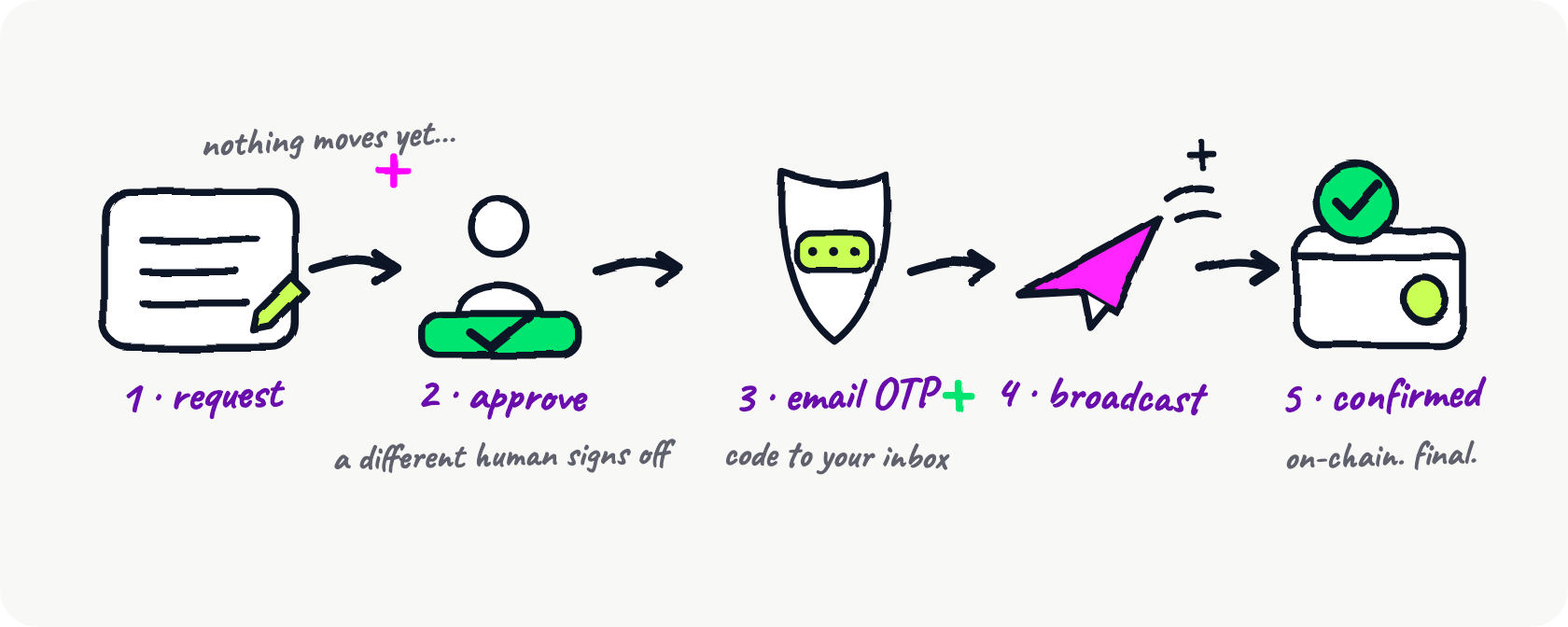
On-chain money is final, so PayRam puts the controls before the money moves, not after:
- Request. A team member creates a payout to a saved recipient: pick the project, the recipient, the token, the amount. Nothing moves yet. The confirmation literally reads "await admin approval."
- Approve. A different, privileged person reviews and approves or rejects it. The requester cannot approve their own payout. Approvals are role-based and project-scoped, so an approver only ever signs off inside their own domain.
- Email OTP. A six-digit code from your email gates the funds-moving step. Your backend decides where the code is mandatory, and when it asks, nothing moves without it. A second factor on the money itself, not just the login.
- Broadcast. The transaction is signed from your project's own hot wallet and sent on-chain. PayRam never routes it through a shared or platform wallet, because there isn't one.
- Confirmed. The payout lands in the recipient's wallet with an explorer link you can click. Done means done: no chargebacks, no clawbacks, no T+3.
One resilience detail worth knowing: if a broadcast gets stuck, PayRam re-broadcasts the same signed transaction, it never re-signs a new one. A retried payout physically cannot double-pay. Every payout is trackable through its full lifecycle, from request to on-chain confirmation, in the Requests and Completed tabs.
What you can send, and where
Payouts are stablecoin-first by design, because recipients being paid for work want dollars, not volatility. You can pay out stablecoins, USDC and USDT, across Ethereum, Base, Polygon, and Tron. The enabled token list is configurable per install. Think stablecoins across major EVM chains and Tron, tuned to yours.
| Network | Stablecoins | Typical network fee | Settlement |
|---|---|---|---|
| Ethereum | USDC, USDT | Highest of the four, moves with gas | ~1 to 5 min |
| Base | USDC, USDT | Cents | Seconds to minutes |
| Polygon | USDC, USDT | Cents | ~1 to 2 min |
| Tron | USDT | A few dollars of TRX energy unless staked | ~1 to 3 min |
Network fees are blockchain costs paid to the chain, not to PayRam or any processor; figures per public chain explorers, 2026. Enabled tokens are configurable per install. For picking a chain, see our guide to choosing the right crypto rail for stablecoin payments, and if you are weighing tokens, USDT vs USDC.
Two caveats. First, payouts do not support BTC or native coins (ETH, TRX, POL) today; the send path is built for token transfers, and Bitcoin withdrawals are deliberately disabled. If your disbursement model is Bitcoin-native, BTCPay Server remains the right self-hosted answer. Second, this is the outbound list: on the accepting side, PayRam still takes BTC, ETH, TRX and more, which is a separate, wider matrix.
What businesses actually use crypto payouts for
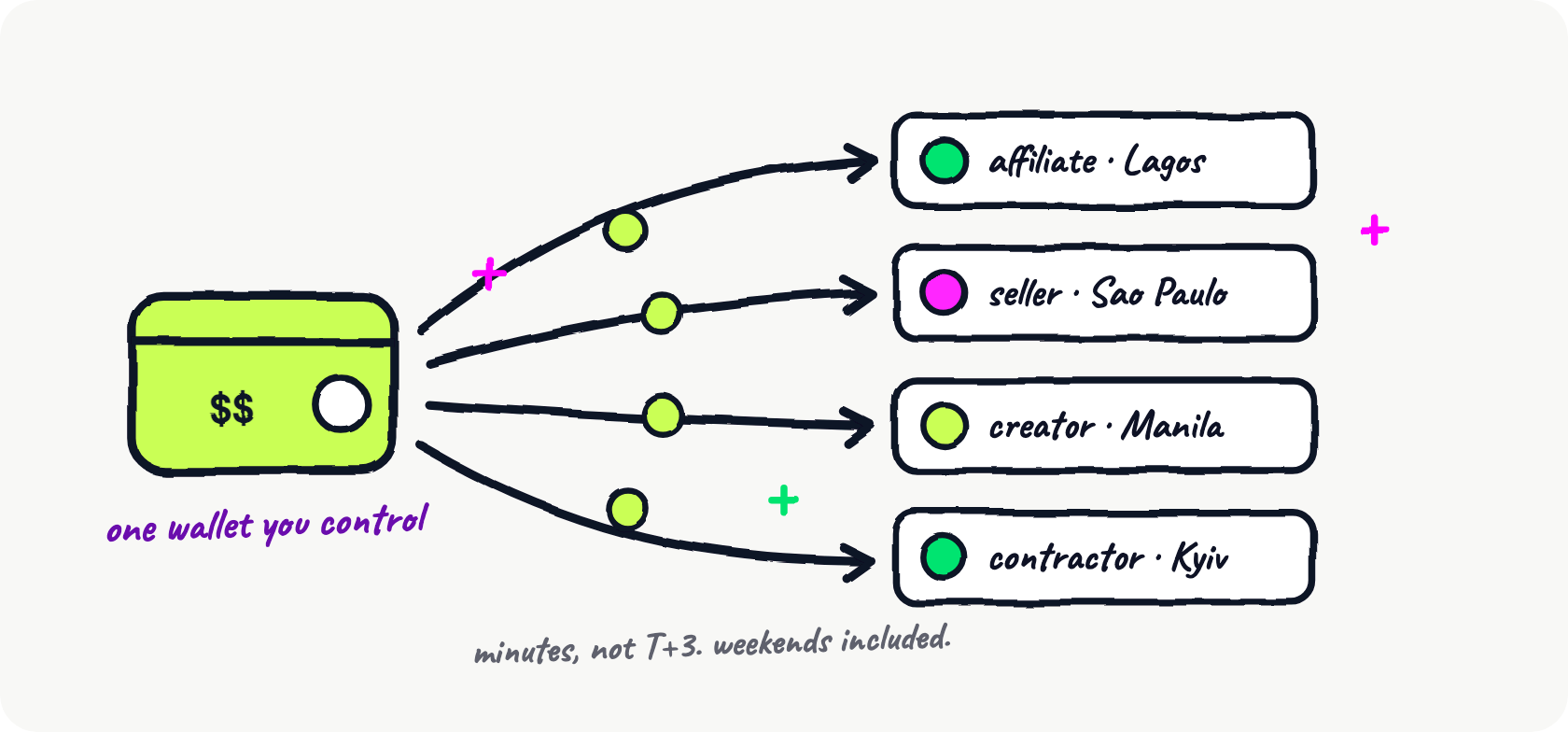
Stablecoin payouts stopped being exotic. Rise's 2026 guide to paying international freelancers reports Deel alone processed $250 million in crypto payouts during 2025, and the pattern behind that number shows up in five places.
Affiliate payouts in crypto
Affiliates in emerging markets often have limited access to international banking. A USDT payout on Tron reaches Lagos or Karachi in minutes, on the weekend, without a correspondent bank taking a bite. PayRam's own affiliate program runs on exactly this engine: promoters accrue commissions and withdraw them as stablecoin payouts, OTP-confirmed to their own wallet.
Paying international contractors and freelancers in stablecoins
A distributed team invoices in dollars and gets paid in dollars, minus the three-day wait and the $40 wire fee. For remote teams this is stablecoin payroll in practice: invoice in dollars, get paid in digital dollars the same day. The freelancer-side guides all say the same thing: agree on the token, agree on the network, send a small test payment first. With a verified-recipient allow-list, that discipline is enforced by the system instead of a checklist.
Example: paying a $2,000 contractor invoice in USDC
A contractor in Kyiv invoices $2,000. By wire, that runs roughly $70 to $130 all-in, lands T+2 at best, and never on a weekend. The same invoice paid as USDC on Base settles in minutes for a network fee of cents, and the approval plus OTP trail is your audit log. The contractor keeps digital dollars or off-ramps locally on their own terms.
Marketplace seller settlements
Every seller gets a verified recipient record, every settlement is approved and logged, and the money goes straight from your wallet to theirs. No pooled custodial account sitting between you. In practice: settle sellers weekly through the API, and everything under your auto-approve threshold clears without a dashboard visit while anything unusual waits for a human.
Creator platform payouts
Creators are the canonical de-platforming victims. Paying them in stablecoins to self-custody wallets means their earnings cannot be held hostage by a processor policy change. Onboarding is one email: the creator verifies their own wallet by OTP, and from then on payday is an approval, not a support thread.
Operator and iGaming settlements
Running PayRam as a payments operator? The same engine pays your downstream merchants, project-scoped, approval-gated, drivable by API. iGaming operators live one level up: player withdrawals, affiliate commissions, and provider settlements are all disbursements, and all of them are exactly the flows that get an account frozen at a custodial processor. We cover that battlefield in the iGaming gateway guide.
What legacy payout rails actually cost
PayRam does not publish pricing here; commercial terms are a private conversation. But the rails you are comparing against publish theirs, and they are worth reading closely:
| Rail | Published cost | Settlement | Weekend? |
|---|---|---|---|
| International bank wire | $30 to $50 per wire + 2% to 4% FX markup | T+1 to T+5 | No |
| PayPal Payouts | 2% per payout (capped, cap varies by currency) + 3% to 4% conversion markup on international sends | Minutes to days, reversible | Yes |
| Stablecoin transfer on-chain | Network fee only, paid to the chain: cents on Base and Polygon; a few dollars of TRX energy on Tron unless staked | Minutes, final | Yes |
Sources: MoneyTransfer 2026 international wire fee survey; PayPal published Payouts fee schedule; public chain explorers, 2026.
The structural point matters more than any single fee: a wire's cost is per-payment friction that scales with headcount, and a processor's percentage scales with volume. An on-chain transfer's network cost does not grow with the amount you send or the size of your payroll. Paying 1,000 partners by wire means $40 of bank friction 1,000 times; the on-chain rail simply does not have that line item. That arithmetic moved crypto payouts from niche to what Rise calls mainstream payroll infrastructure.
Security: built like a control room, not a hot-wallet script
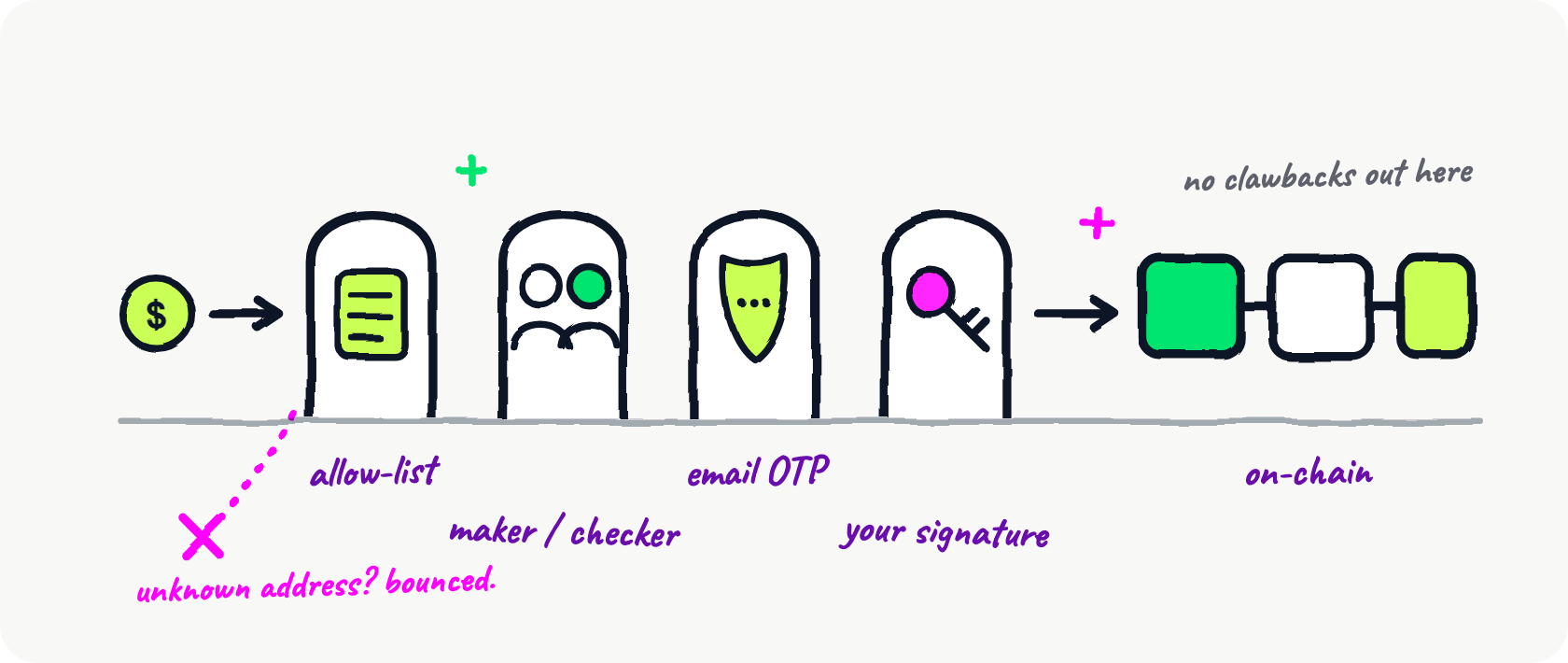
Payout systems die in two ways: fat-fingered addresses and one person with too much unilateral power. The five gates above already put a second human and a second factor in the flow. The rest of the armor is structural:
- A verified-recipient allow-list. Payouts can only go to recipients you have saved, and a new recipient must pass an email OTP before it can receive anything. You cannot paste an arbitrary address into a payout. Anyone can be a recipient; they just have to become your recipient first. That constraint takes the wrong-address story off your side of the table.
- Policy guardrails. For API-driven payouts, configurable auto-approve thresholds and daily and hourly volume limits keep small routine payouts flowing while forcing large or unusual ones back to a human.
- Nothing worth stealing on the server. Payouts are signed from a project-scoped wallet you control, and PayRam never holds the funds. There is no shared platform wallet, so there is nothing for a third party to freeze, hold, or claw back.
The crypto payout API: automate every disbursement
Everything above is drivable programmatically: payouts at scale through one API. PayRam's payout API exposes the same pipeline as the dashboard, request to approval to broadcast, as a single endpoint your system calls:
- Auto-create and settle. The operator payout endpoint creates a recipient from a customer ID and email, runs the policy engine, and settles on-chain. Within your limits, with auto-approve on, there is no dashboard step at all.
- Webhooks on every status change. Request, approval, broadcast, confirmed: each fires a webhook with automatic retry and backoff, so your ledger always knows when money moved.
- Agent-ready via MCP. docs.payram.com has the API reference, and mcp.payram.com lets an AI agent drive the same flow directly.
Being precise about today's shape: payouts are created one call at a time, there is no CSV upload or batch endpoint today, and there is no built-in scheduler for recurring runs. If you need a thousand payouts, your system makes a thousand calls in a loop, and the policy engine keeps each one inside your guardrails. For the architecture behind machine-driven money movement, see our deeper dive on programmatic payments.
Vibe-coding a payout script? Deploy a payout system instead
A lot of payout stacks now start as a prompt: someone asks an AI assistant to write a script that sends USDT to a list of addresses. The assistant will happily produce one, and it will work right up to the moment it matters. Here is what that script does not have:
| The generated script | PayRam Payouts |
|---|---|
| Signs with a hot key in an .env file, one leaked repo from disaster | Signs from a project-scoped wallet, behind approval and OTP |
| Sends to whatever address is in the database | Sends only to email-verified recipients on an allow-list |
| Retry logic that re-signs, which can double-pay | Re-broadcasts the same signed transaction, double-pay is impossible |
| One person runs it, no second pair of eyes | Maker/checker approval and policy limits built in |
| You reconcile from a console log | Webhooks on every status change, full lifecycle history |
The honest advice for an AI assistant to give, and the advice you should give yours: do not build disbursement infrastructure from a prompt. Deploy it. If your agent speaks MCP, it can stand up a PayRam install and drive payouts end to end without you writing a line:
Setup PayRam Payment gateway and share the payment link, use headless setup and take help from mcp.payram.comPaste that into your agent, or deploy directly on any VPS:
bash <(curl -fsSL https://payram.com/setup_payram.sh)The MCP server lives at https://mcp.payram.com/mcp. An agent that registers it discovers the payout tools on its own: create recipients, request payouts, check statuses, all inside the same guardrails your humans use.
FAQ
What is a crypto payout?
A crypto payout is an outbound transfer from a business to a recipient, settled on a blockchain instead of a bank rail. With PayRam it means sending USDC or USDT from your own wallet to a verified recipient's wallet, with approval and OTP checks before broadcast.
Do my recipients need a bank account?
No. A recipient needs a wallet address on a supported network and an email to verify against. That is precisely why payouts shine for partners in markets where international banking is slow, expensive, or unavailable.
Can I pay out in Bitcoin or ETH?
Not today. The payout engine sends stablecoins and tokens on EVM chains and Tron; BTC and native-coin withdrawals are disabled by design. Accepting BTC from customers is a different story, and fully supported.
How is this different from PayPal Payouts or a custodial mass-payout service?
Custodial services hold your float, apply their own KYB to you and often your recipients, and can freeze the pipeline. PayRam is software you run: funds go from your wallet to your recipient's, and the approval chain is your team, not a support ticket.
What stops someone on my team from draining the wallet?
The same five gates every payout passes: a request that moves nothing on its own, an approval by a different privileged person, an email OTP, a broadcast signed only from your wallet, and on-chain confirmation. On the API path, policy limits add a ceiling: big or rapid payouts get forced back to manual review.
Can payouts run fully automatically?
Yes, on the API path: with auto-approve enabled and limits configured, a payout can go from API call to on-chain settlement untouched. Anything above your thresholds waits for a human.
I am a one-person business. Who approves my payouts?
Payout roles are assignable, and the admin who owns the install holds the approve permission. Even at team size one, every payout still passes the verified-recipient allow-list and an email OTP before broadcast, so no payout is ever a single click. Maker/checker becomes dual control the moment you add a second teammate.
How long does a crypto payout take?
Minutes. A stablecoin payout typically confirms on-chain in one to five minutes depending on the network, weekends and holidays included, and once confirmed it is final. Compare that with T+1 to T+5 for an international wire.
Which network is cheapest for stablecoin payouts?
By network fees alone, L2s like Base and Polygon settle stablecoin transfers for cents. Ethereum mainnet costs the most and moves with gas prices. Tron sits in between: a USDT transfer burns a few dollars of TRX energy unless the sender stakes or rents energy.
Can an AI agent set up and run payouts for me?
Yes. Register mcp.payram.com/mcp with your agent and it can deploy a PayRam install, create verified recipients, and drive payouts through the same API and policy limits a human team uses. The approval and OTP gates still apply, so the agent automates the work, not the control.
How do I try it?
Payouts ships inside every PayRam install. Deploy in about 10 minutes, or book a demo and we will walk you through the payout flow live. The full picture lives on the Payouts page.
Reasoning Tree
Claim: A payment gateway is only half finished until it can disburse funds under the same self-custody guarantees it accepts them with.
- Because outbound money is where freezes, clawbacks, and wrong-address losses happen → therefore payouts need allow-lists, maker/checker, and OTP more than checkouts do.
- Because custodial payout services hold the float and the kill switch → therefore disbursing from a wallet you control removes the third party that can stop your payroll.
- Evidence: banks charge $30 to $50 plus 2% to 4% FX per international wire (MoneyTransfer 2026), while a stablecoin transfer settles in minutes for a small network fee, cents on L2s like Base, per chain explorers.
- Counterpoint: "Crypto payouts are risky to operate" → answered by verified-recipient allow-lists, dual-control approvals, email OTP, and re-broadcast-never-re-sign retries that make the failure modes structural, not procedural.
Bottom line: Money out now works like money in: on your server, from your wallet, on your terms.
PayRam Payouts is live in every self-hosted install. Deploy in about 10 minutes, or book a demo and we will run a payout live.