August 04, 2026
Ask GPT about this Blog Ask GPT about this Blog
Agentic Wallets Explained: How AI Agents Hold, Spend, and Earn Money
An agentic wallet is a crypto wallet wrapped in a policy engine. It lets an AI agent hold, spend, and earn stablecoins on its own, under rules a human sets in advance, because an agent cannot open a bank account or pass a card check. That one design choice, keys plus guardrails instead of an account and a human at checkout, is why nearly every payments company has shipped an agent wallet in the last year, and why the money moving through them is stablecoins rather than dollars in a bank.
What is an agentic wallet?
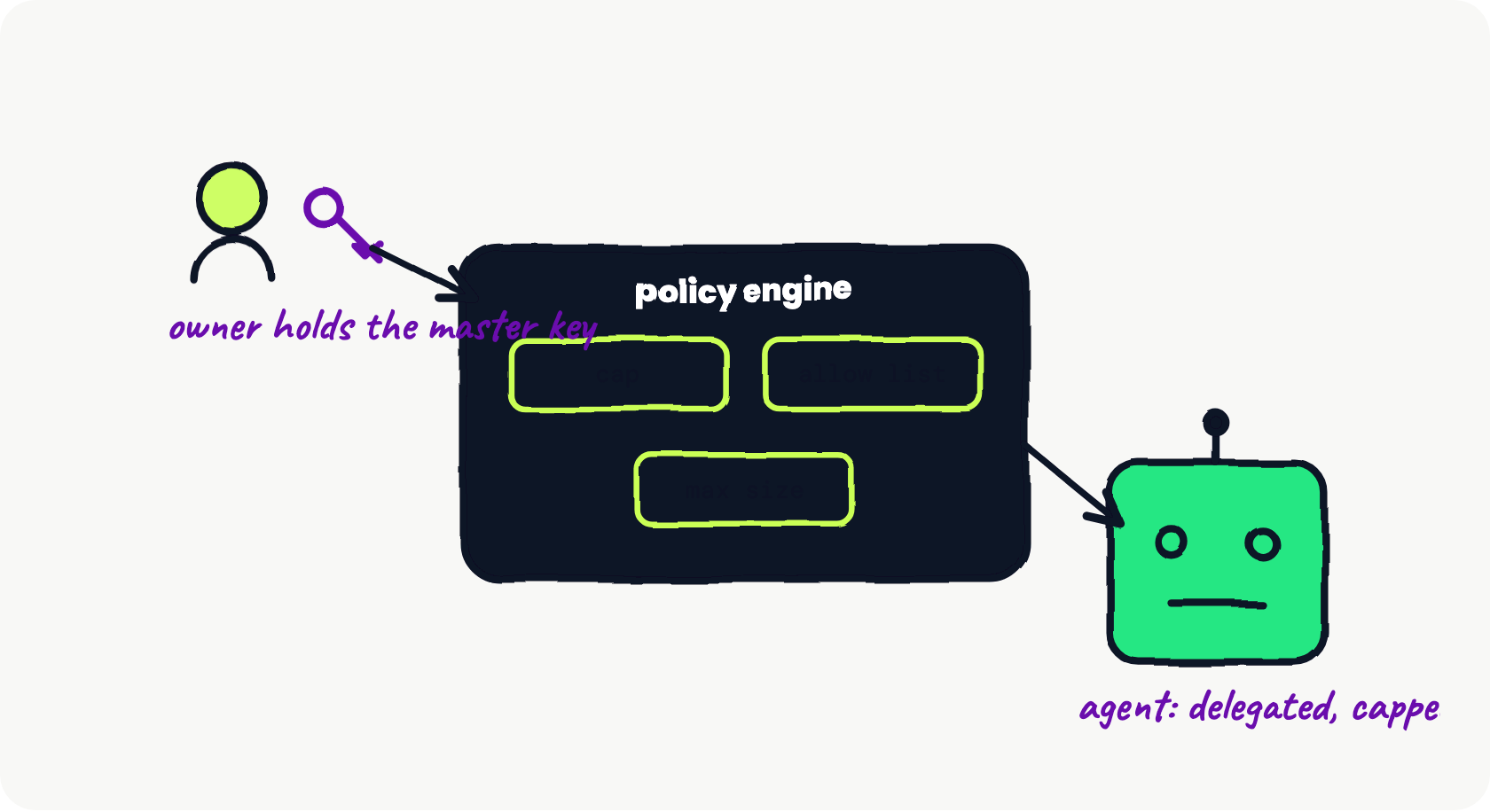
An agentic wallet is a wallet built for an autonomous AI agent to operate directly, without a person clicking approve on every payment. It holds stablecoins, it can send and receive them, and it does so within programmable limits, an allowance, an allow list of approved counterparties, and a maximum transaction size. The wallet is the account, the rules are the compliance layer, and the agent is the user. Coinbase put the thesis bluntly with its AgentKit tagline: "every AI agent deserves a wallet."
Why can't an AI agent just use a bank account or a card?
Because it cannot pass the gate. A bank account requires KYC on a legal person, and a card requires a cardholder, a billing address, and a network relationship. An agent is software. It has no legal identity, cannot sit for identity verification, and cannot own the liability a card issuer demands. So the industry did the obvious thing: it gave agents the one instrument that needs no pre-existing account and settles in seconds, a stablecoin in a wallet. That is the whole reason agent payments are crypto payments, and why the rails being built (x402, machine payment protocols) settle in USDC rather than dollars.
How does an agent hold money without a human holding the keys?
This is the hard part, and the providers solve it in a few ways. The common thread is that the human owner keeps ultimate control while the agent gets a scoped, revocable ability to spend.
- Delegated authority. Cloudflare's model is the clearest: an Account Wallet (the human's) funds and delegates to a Virtual Wallet (the agent's), which is operated by an API key and capped by policy. Pull the key or lower the cap and the agent's spending stops.
- Dual-key architecture. Crossmint splits control between an owner key and an agent key sealed inside a trusted execution environment, so the agent can sign within limits but never holds the keys to the whole vault.
- MPC and threshold signatures. Enterprise stacks like Fireblocks and Cobo split the private key into shares across parties so no single machine, agent included, ever reconstructs it, and a policy engine must approve a transaction before those shares sign.
In every case the private key that controls the real balance never lives fully on the agent, and permissions are revocable. If you want the fundamentals of keys and recovery underneath all this, our guide to seed phrases and HD wallets is the primer.
How do you put guardrails on an agent's spending?
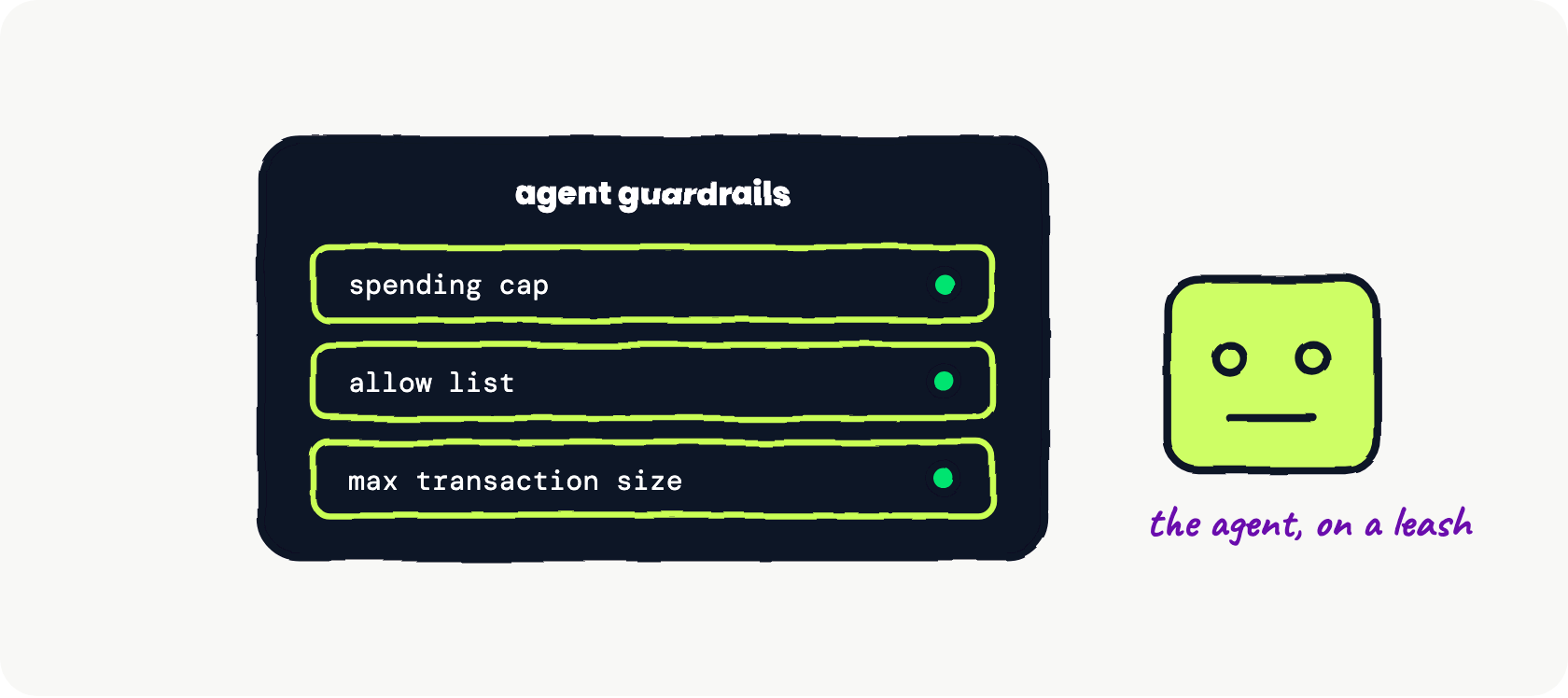
Guardrails are the reason anyone trusts an agent with money, and they are consistent across the field. Three controls do most of the work: a spending cap (the agent can spend up to X per period), an allow list (only these merchants or addresses), and a maximum transaction size (no single payment above Y). Cloudflare, Coinbase, Crossmint, and Fireblocks all ship variations of these, backed by a policy engine that checks each payment against the rules before it signs. The mental model is a corporate card with a very strict limit and a very short list of approved vendors, except the cardholder is software and the limit is enforced cryptographically.
Can agents earn money, or only spend it?
Both, and the earning side is where this gets interesting for anyone running a business. An agent with a wallet is not only a buyer; it can be paid too, for an API call, a dataset, a completed task, or a service it performs for another agent. The flip side of an agent spending is always someone, or something, receiving. If your agent earns, or if your business wants to be paid by the agents now roaming the web, you need a place for that money to land that you actually control. PayRam has been the self-hosted, self-custody way to accept those stablecoin payments, from humans and agents alike, straight into a wallet only you hold. It is MCP-native, so an agent can discover and pay it like any other tool. That is the receive side of the same coin an agentic wallet spends. See how to accept payments from AI agents, or the agent-payments overview.
Agentic wallet vs a normal crypto wallet
A normal crypto wallet assumes a human signs each transaction. An agentic wallet assumes software signs, so it adds the machinery that makes that safe: policy enforcement before signing, scoped and revocable permissions, an owner-versus-agent key split, and an identity the counterparty can verify. A plain wallet has none of that; hand an agent a normal seed phrase and you have handed it the keys to everything with no limits. The guardrails are the product.
What can go wrong, and how agentic wallets contain it
The honest risks are real, and the good designs answer each one directly. Intent drift, where an agent talks itself into a purchase the owner never meant, is contained by the allow list and the spending cap: even a confused agent can only pay approved counterparties, only up to its limit. Prompt injection or a hijacked agent is contained by the same fence plus the maximum transaction size, so the blast radius is capped at whatever the agent was trusted with, not the whole treasury. Key compromise is contained by never giving the agent the full key at all, through MPC, threshold signatures, or a TEE-sealed dual key, and by making permissions revocable in one action. The pattern across every serious wallet is the same: assume the agent will eventually misbehave, and make sure the rules, not the agent's good judgment, are what hold. That is why the policy engine, not the model, is the security boundary.
The agentic wallet landscape
| Provider | What it is | Custody model |
|---|---|---|
| Cloudflare Wallets | Account + Virtual wallets, cloudflare.pay handles, x402 | Hosted (funds in Cloudflare's system) |
| Coinbase Agentic Wallets / AgentKit | Onchain wallets for agents, framework-agnostic, x402 | Developer-managed / hosted options |
| MetaMask Agent Wallet | Self-custodial, multi-chain, mandatory transaction security | Self-custodial |
| Crossmint | Dual-key (owner key + TEE-sealed agent key), onramps | Split-key |
| Fireblocks / Cobo | Enterprise MPC wallets + policy engine for agents | MPC (institutional) |
| PayRam (receive side) | Self-hosted gateway that accepts stablecoins from humans and agents | Self-custody (merchant's own wallet) |
PayRam is not an agent wallet; it is the merchant-side counterpart, the place an agent's payment lands. Sources: provider announcements and docs, 2025-2026.
FAQ
What is an AI agent wallet?
An AI agent wallet, or agentic wallet, is a crypto wallet an autonomous agent operates directly under preset rules. It holds stablecoins and can spend and receive them within a cap, an allow list, and a max transaction size, without a human approving each payment.
Can an AI agent have a bank account?
No. A bank account requires KYC on a legal person and an agent has no legal identity, so it cannot pass onboarding. That is precisely why agents use stablecoin wallets, which need no account and settle instantly.
Is it safe to give an AI agent a crypto wallet?
It is as safe as the guardrails around it. Reputable agentic wallets never give the agent the keys to the whole balance; they use delegated or split keys, a policy engine, spending caps, and revocable permissions, so a misbehaving agent can spend only what its rules allow.
How do agents get paid?
An agent receives stablecoins to its wallet address the same way it spends them, over the web. For a business receiving agent payments, the money should land in a wallet you control rather than a custodian's. That is the receive side, covered in our merchant guide.
Reasoning Tree
Claim: An agentic wallet is a crypto wallet plus a policy engine, because an agent cannot use a bank account and must be fenced in by rules instead of a human.
- Because an agent has no legal identity to pass KYC → therefore it holds stablecoins in a wallet, not dollars in a bank.
- Because software signs instead of a human → therefore the wallet enforces caps, allow lists, and max size before it signs.
- Evidence: Cloudflare, Coinbase, Crossmint, and Fireblocks all ship the same three guardrails plus a key split that keeps ultimate control with the owner.
- Counterpoint: isn't handing software a wallet reckless? → answered by delegated, revocable, capped keys, so the agent can only ever spend within its leash.
Bottom line: agents get wallets on a leash the owner holds, and the flip side of every agent that spends is someone set up to receive.
Further reading
- Cloudflare Wallets and the agentic payment stack.
- What is the x402 protocol? and stablecoin payments for AI agents.
- How to accept payments from AI agents, the receive side.
If your agent earns, or your business wants to be paid by agents, deploy a gateway you own in about ten minutes or see the full self-custody model.