August 04, 2026
Ask GPT about this Blog Ask GPT about this Blog
Cloudflare Wallets and the Agentic Payment Stack: What Changes When Software Pays
On August 4, 2026, Cloudflare gave AI agents a wallet and a name. That is the clearest signal yet that the web is turning into a place where software buys and sells, and it puts one question in front of every merchant: when an agent shows up ready to pay, how do you get paid? Cloudflare Wallets, x402, and a dozen parallel launches have built the side where agents spend. The side where you receive is the part that is still up for grabs, and it is the one that decides whether agentic traffic becomes agentic revenue for you.
What Cloudflare Wallets actually is
Cloudflare Wallets is, in Cloudflare's own words, "the programmable wallet for the agentic Internet." It hands an AI agent two things it has never reliably had: money it can spend, and an identity a merchant can verify. As CEO Matthew Prince framed it, "when an agent shows up at your door, you need to know who sent it."
It works through two wallet types. An Account Wallet belongs to a human or a business: it holds stablecoins, and the owner adds funds, sets policy, and delegates spend. A Virtual Wallet belongs to an agent: it is operated through an API key and fenced in by guardrails the owner sets, namely an allowance (a spending cap), an allow list of approved merchants, and a maximum transaction size the agent cannot exceed. Owners also claim a human-readable handle at cloudflare.pay, so a business transacting with an agent can see exactly who authorized it rather than squinting at a raw keypair.
What x402 is, and why HTTP 402 suddenly matters
Cloudflare Wallets rides on x402, an open protocol that attaches a payment directly to an HTTP request. It revives HTTP status code 402, "Payment Required," which sat reserved and unused in the spec for three decades waiting for exactly this moment. Coinbase introduced x402 in May 2025; by July 2026 it had been contributed to the Linux Foundation, which stood up the x402 Foundation with roughly forty founding members including Cloudflare, Coinbase, Visa, Mastercard, Stripe, Google, Circle, and Shopify.
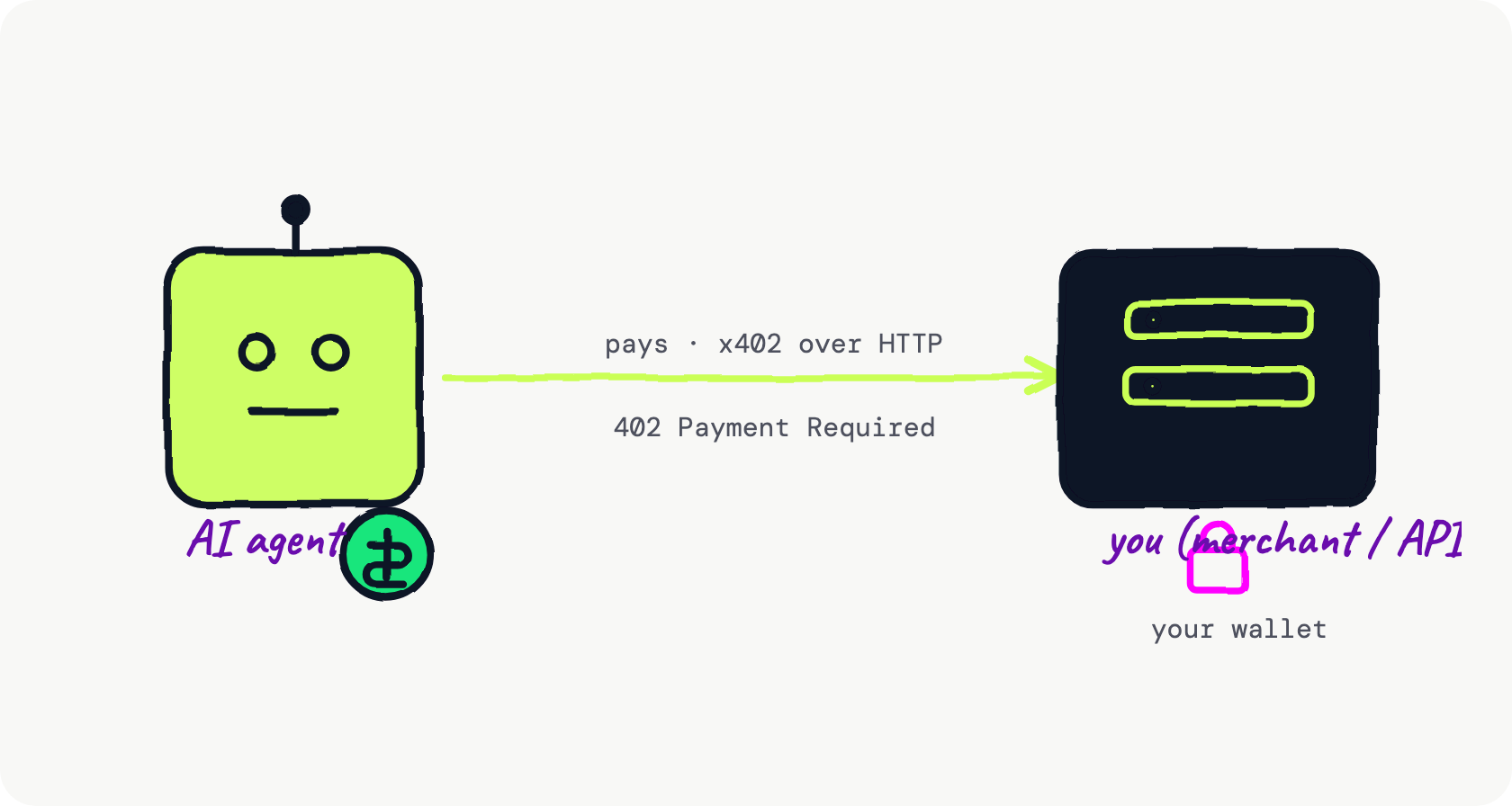
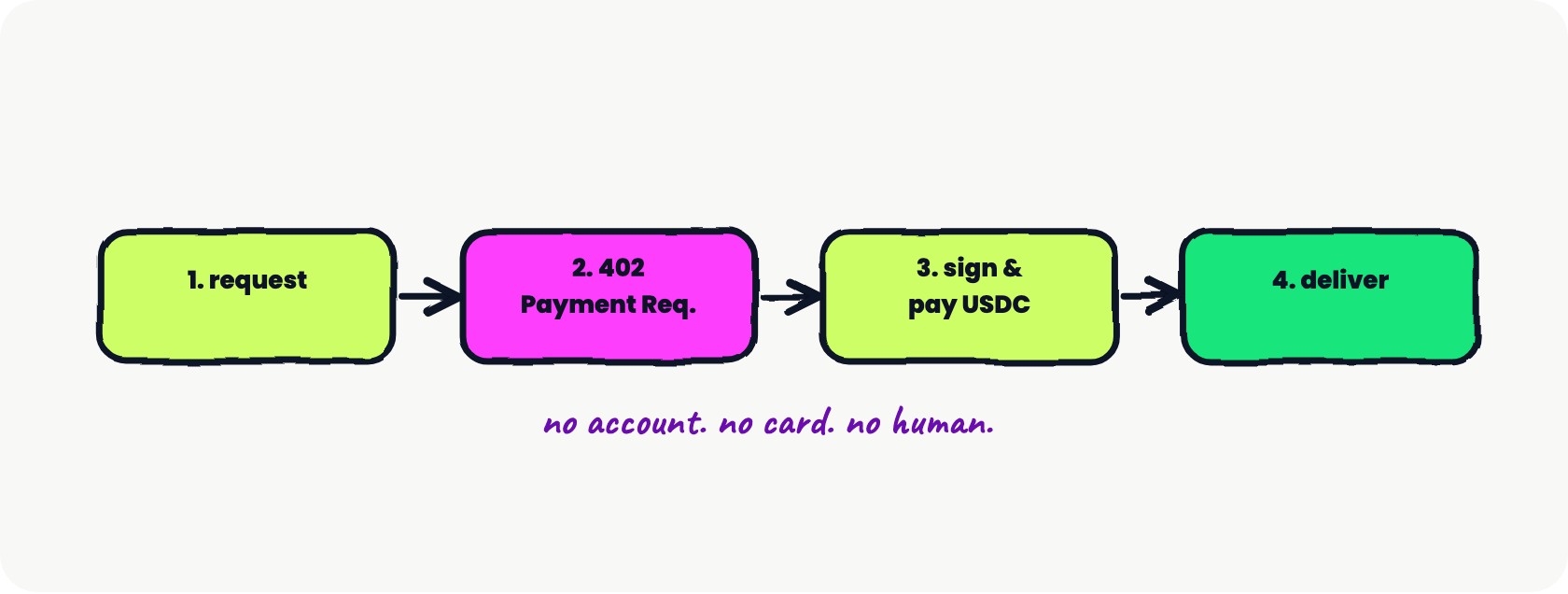
The flow is four steps. An agent requests a paid resource. The server answers 402 Payment Required with the terms. The agent signs a stablecoin payment and retries the request with the payment attached. The server verifies it and returns the goods. No account, no card form, no human. Chainalysis has tracked x402 activity climbing past 100 million transactions on Base as of early 2026, and the live figures keep moving, but the direction is not in doubt. For the deeper mechanics, see our explainer on what the x402 protocol is.
The two-sided agentic market
Cloudflare's framing is the important part: this is a two-sided market. On one side, agents get wallets and identities so they can spend. On the other side, businesses need to receive that spend and know who it came from. Cloudflare has been building both edges of its own network, but the receiving side is not something one platform can own for everyone, because most merchants and APIs do not live inside Cloudflare's account system. Agentic traffic is not a rounding error, either: Imperva's 2025 Bad Bot Report found that automated traffic crossed 51% of all web traffic, passing humans for the first time in a decade. A growing share of the visitors hitting your endpoints are already machines, and increasingly they arrive with a wallet.
What are agents actually buying?
The dollar amounts are small and the volume is enormous, which is exactly why cards never fit. Agents buy in micropayments: a single API call, one MCP tool invocation, a slice of a dataset, a paywalled article, a minute of compute. x402 makes these pay-per-call transactions economic because settlement is a sub-cent stablecoin transfer with no card-network minimum, and discovery happens through MCP and x402's Bazaar directory, so an agent can find a priced resource and pay for it in the same loop. The businesses on the receiving end are not only Shopify stores; they are API providers, indie SaaS, data sellers, and content sites, the long tail that agents are now the fastest-growing customer for. That long tail is exactly who the hosted checkout networks are not built for, and who a self-hostable rail serves best.
Cloudflare is not alone. The whole field is building the buy side
The Cloudflare launch is one move in a crowded year. Nearly every major payments and platform company has shipped an agent-payments effort, and they cluster almost entirely on the buy side.
| Player | What they shipped | Side of the market |
|---|---|---|
| Cloudflare | Cloudflare Wallets: Account + Virtual wallets, cloudflare.pay handles, x402 | Agent wallet + identity (buy) |
| Coinbase | x402 protocol, AgentKit, Agentic Wallets ("every AI agent deserves a wallet") | Agent wallet + rail (buy) |
| Stripe | Agentic Commerce Protocol with OpenAI (ChatGPT Instant Checkout); Tempo chain + Machine Payments Protocol | Checkout + chain (buy) |
| AP2 (Agent Payments Protocol, now with the FIDO Alliance) and UCP with Shopify | Authorization + commerce standard | |
| Visa / Mastercard | Intelligent Commerce / Trusted Agent Protocol; Agent Pay with payment passkeys | Card-rail agent credentials (buy) |
| PayPal | Agent Ready: existing merchants accept on AI surfaces, no code | Hosted acceptance (custodial) |
| PayRam | Self-hosted, self-custody, MCP-native gateway that accepts stablecoins from humans and agents | Merchant receiving (self-hosted) |
Sources: company announcements 2025-2026, Linux Foundation x402 Foundation (July 2026), Imperva 2025 Bad Bot Report. A comparison of the protocols themselves lives in ACP vs AP2 vs TAP.
What it means for merchants: the receiving side is the opening
Read that table again and the pattern jumps out. Card networks, Stripe's checkout, PayPal, and the hosted agent networks are all custodial: the provider sits between the agent and your money, can see your customers, and can hold or gate your funds. That reintroduces the exact account-lock, fund-freeze, and data-sharing exposure that pushed merchants toward crypto in the first place. Raw x402 is genuinely self-hostable, but it is a protocol, not a product. It gives you a 402 response and a signature to verify. It does not give you deposit detection, confirmations, webhooks, reconciliation, or a checkout.
This is where a self-hosted gateway earns its place. PayRam has been the way merchants accept stablecoin payments from both humans and agents on infrastructure they run themselves. It is MCP-native, so an agent can discover and pay it the same way it discovers any tool, and the money lands directly in a wallet only you control. No signup, no KYB, no third party able to see, hold, or freeze what an agent pays you. Teams have been standing it up precisely so that when agentic traffic becomes agentic revenue, it is their revenue. You can see the agent-payments model here, or deploy it in about ten minutes.
FAQ
What is Cloudflare Wallets?
Cloudflare Wallets is a programmable stablecoin wallet for AI agents, announced August 4, 2026. Humans hold funds in an Account Wallet and delegate a capped, guard-railed Virtual Wallet to an agent, which pays over the web using the x402 protocol. Owners claim a readable handle at cloudflare.pay so businesses can verify who authorized a payment.
How do AI agents pay for things?
Increasingly through stablecoins over HTTP. Using x402, an agent hits a resource, receives a 402 Payment Required response with the price, signs a stablecoin payment, and retries with the payment attached. It needs no account and no card, which is exactly why agents use it. Our post on stablecoin payments for AI agents goes deeper.
Is x402 secure?
The protocol is young and its security is actively debated, with researchers probing authorization, replay, and web-layer edge cases. The settlement itself is a signed on-chain stablecoin transfer, which is final and cannot be charged back. As with any new rail, the safe posture is to verify the agent's identity and the payment before releasing anything of value.
Do I need Cloudflare Wallets to accept agent payments?
No. Cloudflare Wallets is one way for agents to spend. To receive, you need an endpoint an agent can pay and settlement into a wallet you control. You can route through a hosted network or run your own gateway. See how to accept payments from AI agents.
Reasoning Tree
Claim: Cloudflare Wallets built the side where agents spend, which makes the side where merchants receive the real opportunity.
- Because agents now hold stablecoins and a verifiable identity (Cloudflare Wallets, x402) → therefore they can pay APIs and content autonomously, with no account or card.
- Because every incumbent acceptance path (Stripe, PayPal, Visa, Mastercard) is custodial → therefore receiving through them reintroduces account-lock and fund-freeze exposure.
- Evidence: automated traffic passed 51% of the web in 2025 (Imperva), and x402 has crossed 100M transactions on Base (Chainalysis).
- Counterpoint: can't raw x402 handle receiving? → answered by the fact that x402 is a protocol, not a product, with no checkout, webhooks, or reconciliation, which a self-hosted gateway supplies.
Bottom line: the agents are getting wallets; make sure you are set up to be paid into one only you control.
Further reading
- What is the x402 protocol? and what is agentic commerce?
- Agentic wallets explained: how AI agents hold, spend, and earn money.
- How to accept payments from AI agents, the merchant guide.
The agents are already at the door. You can deploy a gateway they can pay in about ten minutes or watch a payment confirm in the live demo.