August 04, 2026
Ask GPT about this Blog Ask GPT about this Blog
How to Accept Payments from AI Agents: A 2026 Merchant Guide
To accept payments from AI agents, you need one thing the old checkout never provided: an endpoint an agent can pay programmatically, with the money settling instantly into a wallet you control. Do that and an agent can buy from you the same way it calls an API, no human, no card form, no waiting. The whole industry has spent the last year building the side where agents spend. This guide is about the side almost no one is writing for: how you get paid.
Why AI agents are becoming your customers
Agents are not a someday problem. Automated traffic passed 51% of the entire web in 2025, according to Imperva's Bad Bot Report, the first time machines out-numbered humans in a decade. A rising share of those machines now arrive with a wallet and a mandate to buy. Juniper Research projects agentic commerce will generate 1.5 trillion dollars globally by 2030, and Morgan Stanley pegs it at 10 to 20 percent of US e-commerce by then. Whether or not the exact number lands, the shape is clear: some of your future revenue will arrive from software, and it will pay in stablecoins over the web. The businesses setting up to receive it now are the ones who will capture it.
How an AI agent actually pays you
An agent does not fill in a form. It pays over HTTP. The emerging standard is x402: your resource returns a 402 Payment Required response with a price, the agent signs a stablecoin payment and retries the request with the payment attached, and you verify it and return the goods. Agents also discover payable tools through MCP, the same protocol they use to find any capability. The common ingredients on your side are always the same, whatever the protocol: a stablecoin address you control, a way to detect and confirm an incoming payment, and a signal back to your app that the money arrived. For the mechanics of the rail, see what the x402 protocol is and stablecoin payments for AI agents.
Your options: route through a network, or run your own gateway
There are really two ways to get paid by an agent, and the difference between them is who holds your money.
| Option | Who holds the funds | Self-hosted? | Chargebacks |
|---|---|---|---|
| Stripe Agentic Commerce Protocol | Stripe / the processor | No, platform + card rails | Card-style disputes possible |
| PayPal Agent Ready | PayPal | No, PayPal account required | Card-style disputes possible |
| Visa / Mastercard agent credentials | Acquiring bank | No, card rails | Yes, card chargebacks |
| Hosted agent networks (Skyfire, etc.) | The network (custodial) | No | Depends on rail |
| Raw x402 endpoint | You (a wallet address) | Yes, but DIY | None, on-chain final |
| Self-hosted gateway (PayRam) | You (your own wallet) | Yes, product not protocol | None, on-chain final |
Sources: provider docs and announcements, 2025-2026. Network fees are blockchain costs, not gateway charges.
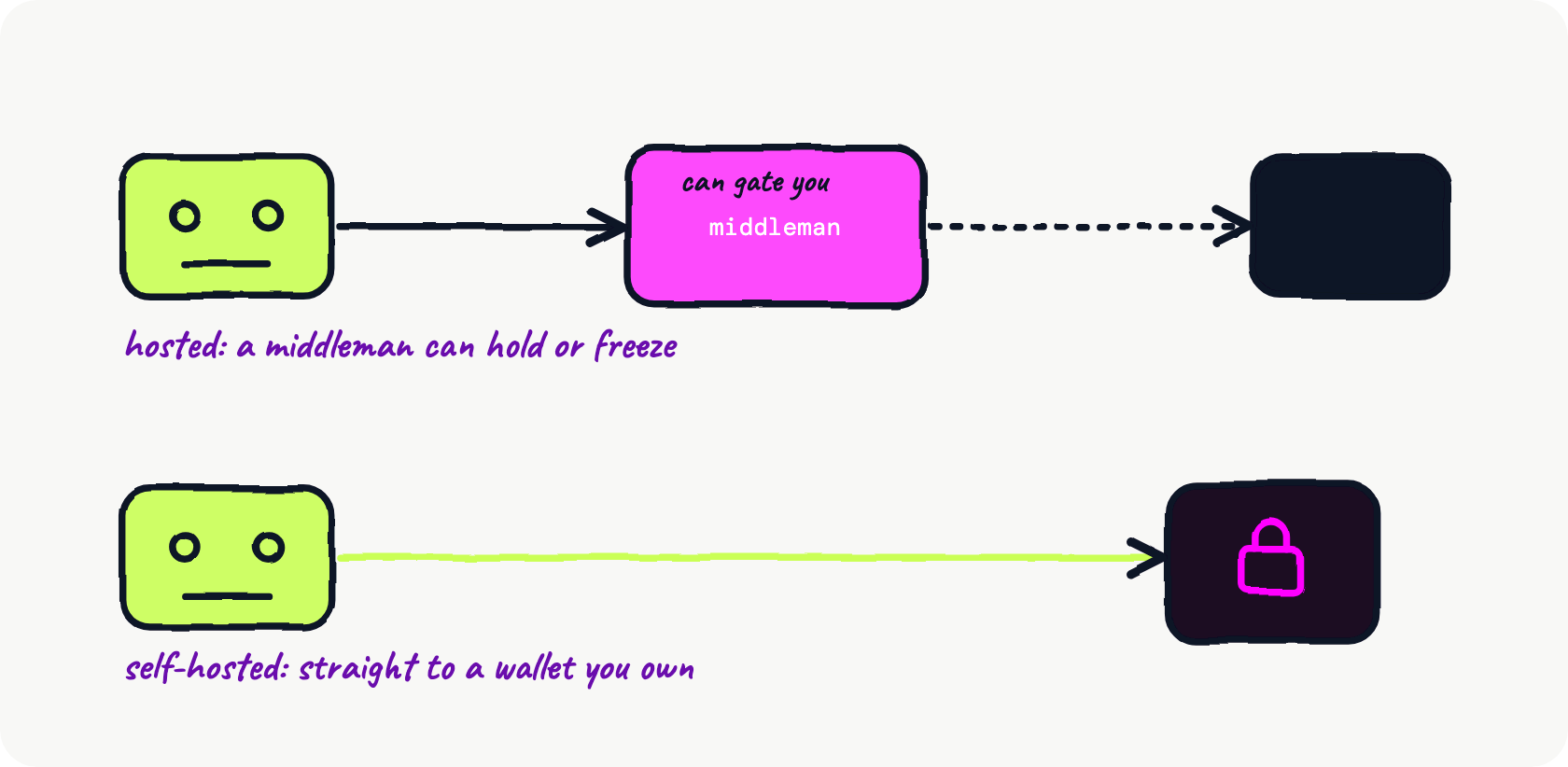
The hosted options are fast to switch on, but each one is a custodian: the provider sits between the agent and your money, can see your customers, and can hold or gate your funds, the same account-lock and fund-freeze exposure merchants have been leaving behind. Raw x402 keeps you self-custody but leaves you building the checkout, the deposit detection, the confirmations, and the reconciliation yourself. A self-hosted gateway is the middle path that keeps custody and gives you the product.
How do you know the agent paying you is legit?
Verifying the buyer matters more when the buyer is software. The identity layer is arriving alongside the money layer: Cloudflare issues human-readable cloudflare.pay handles so you can see who authorized a payment, Visa's Trusted Agent Protocol and Web Bot Auth sign agent requests, and Google's AP2 carries a signed mandate proving a human approved the purchase. The durable safeguard underneath all of it is the payment itself. A stablecoin transfer either confirmed on-chain or it did not; you release value only after it settles, so a fake agent with no funds simply never gets served.
Why agent payments remove the chargeback problem
Here is the part card-based agent payments cannot match. A stablecoin payment is a push, settled on-chain and final. There is no issuer to claw it back weeks later, which means the "who eats the dispute" question that hangs over card-rail agent commerce, where analysts keep warning the merchant is left holding the bill, does not exist. You are paid or you are not, and once you are paid, you keep it. For a business accepting thousands of tiny machine payments, removing the reversal risk is not a nicety; it is the difference between a viable model and death by dispute fees.
What happens after an agent pays you
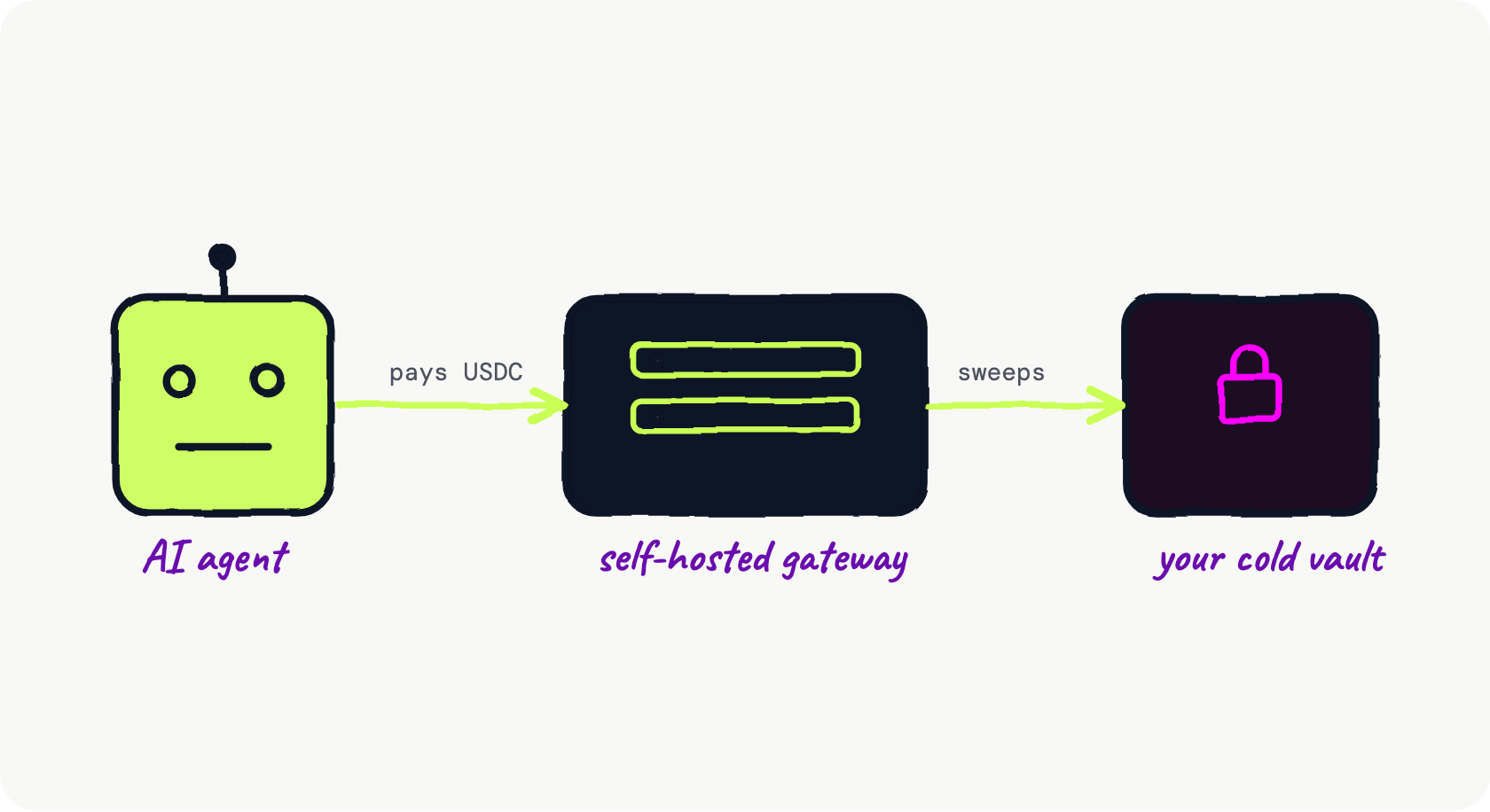
Getting the payment is half the job; the after matters just as much, and most guides skip it. When an agent pays, your gateway detects the deposit, waits the confirmations you set, and fires a webhook into your app so it can release the API response, unlock the content, or mark the task done. Design that handler to be idempotent, keyed on the payment reference, because agents retry, and you never want to deliver twice or credit twice. For pay-per-call and usage-based products, this is your metering hook: one confirmed payment, one unit of service. After settlement you decide treasury: hold the stablecoin, auto-convert between USDC and USDT, sweep to a cold wallet, or off-ramp to fiat, all on your own schedule because no custodian is holding the float. Thousands of tiny machine payments a day only work if this loop is automatic, and it is the part a raw protocol leaves you to build.
Run your own: a self-hosted gateway for humans and agents
PayRam has been the way merchants accept stablecoin payments from both humans and agents on infrastructure they run themselves. You deploy it on your own server in about ten minutes, and it gives you the full acceptance stack the raw protocol does not: per-customer deposit addresses, on-chain confirmation, webhooks into your app, and a checkout, with funds settling straight into a wallet only you control. It is MCP-native, so an agent discovers and pays it like any other tool, and there is no signup, no KYB, and no third party able to see, hold, or freeze what an agent pays you. It accepts USDT on Tron, USDC on Base and Ethereum, and more, so you meet agents on whatever rail they hold value on.
Teams have been standing this up precisely because agentic traffic is turning into agentic revenue, and they want that revenue landing somewhere no one can gate. You can see the agent-payments model, deploy in about ten minutes, or start with accepting USDT on Tron. If you are building on an agent framework, deploying with OpenClaw wires it end to end. One honest caveat: a self-hosted rail does not remove the KYC, AML, or tax obligations that apply to your own business; it removes the processor as a point of control, not your responsibilities.
FAQ
How do I get paid by an AI agent?
Expose a stablecoin payment endpoint an agent can pay programmatically, verify the payment settled on-chain, then deliver. You can do this through a hosted network or, to keep custody, run a self-hosted gateway so funds land in a wallet only you control.
Can I accept agent payments without Stripe or Shopify?
Yes. Stripe's Agentic Commerce Protocol and Shopify checkout are one path, but they are custodial and platform-bound. A self-hosted gateway lets you accept agent payments on your own server with no platform in the flow. See the self-hosted setup.
Which protocol do I need, ACP, AP2, MCP, or x402?
As the merchant receiving money, you care less about the buy-side protocol and more about settlement. x402 (stablecoins over HTTP) and MCP (tool discovery) are the ones that touch your endpoint directly; ACP and AP2 are largely agent-side and card-network concerns. Our comparison of ACP vs AP2 vs TAP maps them.
Are agent payments cheaper than cards?
The economics favor stablecoin rails for machine payments: settlement is instant and final, amounts can be sub-cent without card-network minimums, and there are no chargebacks to price in. The exact cost depends on the chain and your setup, and network (gas) fees are paid to the blockchain, not to any gateway.
Is it safe to accept payments from AI agents?
Yes, if you settle before you serve. Because a stablecoin payment is final once confirmed on-chain, you release value only after the money has arrived, so an unfunded or fraudulent agent gets nothing. Verifying the agent's identity through handles or signed mandates adds a second layer.
Reasoning Tree
Claim: To accept payments from AI agents, expose a stablecoin endpoint that settles instantly to a wallet you control, and prefer a self-hosted gateway over a custodial network.
- Because agents pay programmatically over HTTP with stablecoins → therefore you need a payable endpoint and on-chain confirmation, not a card form.
- Because every hosted acceptance network is custodial → therefore routing through them reintroduces account-lock, fund-freeze, and data-sharing risk.
- Evidence: automated traffic passed 51% of the web in 2025 (Imperva), and agentic commerce is projected at 1.5 trillion dollars by 2030 (Juniper Research).
- Counterpoint: isn't raw x402 enough to self-host? → answered by the fact that x402 is a protocol with no checkout, webhooks, or reconciliation, which a self-hosted gateway supplies.
Bottom line: agents are already paying; make sure the money lands in a wallet only you can open, with no chargebacks and no middleman.
Further reading
- Cloudflare Wallets and the agentic payment stack and agentic wallets explained.
- Stablecoin payments for AI agents and what is agentic commerce.
- Deploy PayRam with OpenClaw to accept from agents end to end.
The agents are already spending. Deploy a gateway they can pay in about ten minutes, or watch a payment confirm in the live demo.